


Reliable communication matters when vehicles and crews need to coordinate quickly. On a construction site, drivers may need to communicate with plant operators before moving through an active work area. Truck drivers may need contact with other vehicles or site personnel, while fleet and response teams may need a simple way to communicate between vehicles without making individual phone calls.
This is where UHF radio and antenna systems in Australia continue to have a practical role. A good setup is not simply a radio installed in the dashboard. The radio, antenna, antenna position, mounting hardware and operating environment all affect how useful the system will be in day-to-day work.
Choosing the right equipment can also be less straightforward than it first appears. A 5 watt radio does not guarantee the same communication range in every location, and a higher-gain antenna is not automatically the better choice. A vehicle working mainly on open highways may benefit from a different antenna setup than a construction vehicle operating around hills, buildings and heavy equipment.
This guide explains how UHF radio systems in Australia work, what to consider when choosing a radio and antenna, how antenna gain affects performance, and what fleet operators should think about before installing UHF equipment across multiple vehicles.
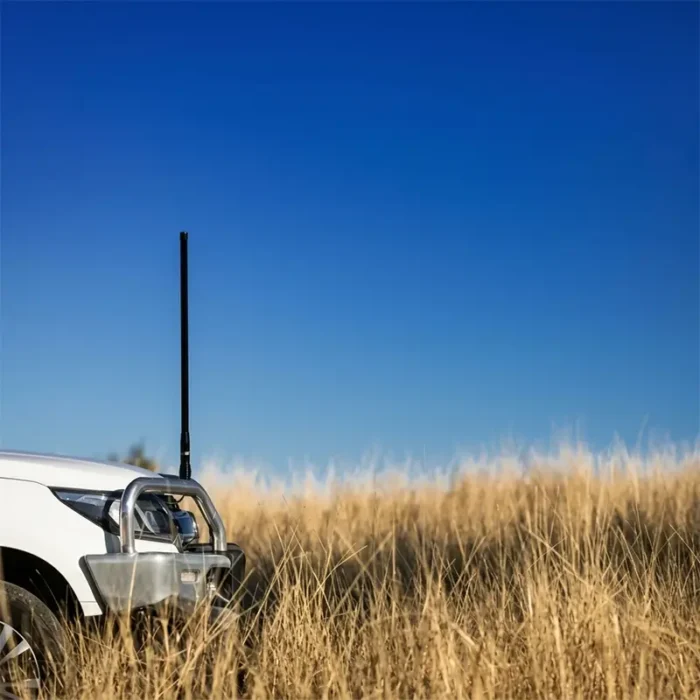
Vehicle-mounted UHF radio and antenna systems for communication across Australian work, fleet and specialist vehicle applications.
What Makes Up a Vehicle UHF Communication System?
The radio is the most visible part of the setup inside the cab, but it is only one part of a complete communication system. A typical vehicle installation combines the radio with an external antenna, coaxial cable, mounting hardware, power connection and microphone. The quality and suitability of each component can influence the overall result.
The radio handles the communication itself, while the antenna transmits and receives the radio-frequency signal. The antenna’s design, gain and position on the vehicle affect how that signal is distributed around the vehicle and surrounding terrain.
For permanent vehicle UHF communication systems in Australia, mounting also matters. The radio needs to be positioned where it can be operated safely and practically, while the antenna needs an appropriate external mounting point. Cable routing, brackets and power connections should be considered during the initial installation rather than added as an afterthought.
This is why choosing a complete UHF setup is generally more useful than comparing radios based on specifications alone.
How Does UHF CB Radio Work in Australia?
UHF CB provides short-distance two-way radio communication over shared frequencies. In Australia, the Australian Communications and Media Authority (ACMA) currently allocates UHF CB frequencies from 476.425 MHz to 477.4125 MHz. Users do not need to apply individually for a CB class licence or pay a licence fee, but equipment and operation must comply with the conditions of the class licence.
For vehicle operators, the practical benefit is straightforward: compatible radios operating on the same appropriate channel can communicate directly with each other. This makes UHF CB radio in Australia useful in many vehicle-based environments where drivers, crews or operators need regular short-range communication.
The service also provides designated repeater channels and emergency channels. ACMA currently identifies UHF channels 5/35 for emergency messages and specific channel pairs for repeater operation.
UHF CB should still be understood as a shared radio service. It is not a private communications network, and communication performance will vary according to terrain, obstructions, equipment and local conditions.
Vehicle-Mounted vs Handheld UHF Radio: Which Makes Sense?
Both have a place, but they solve different problems.
A vehicle mounted UHF radio in Australia is generally suited to drivers and operators who regularly communicate from inside the vehicle. The radio has a permanent power source and can be paired with an externally mounted antenna selected for the vehicle and its normal operating environment.
A handheld radio provides portability. This can be useful when a worker needs to leave the vehicle and continue communicating on foot. The trade-off is that handheld units have different antenna, battery and installation characteristics from a properly configured in-vehicle system.
For many commercial operations, the choice does not necessarily have to be one or the other. A permanently installed in-vehicle UHF CB radio may provide the main vehicle communication system, while portable radios can support team members who need to work away from the cab.
When choosing between the two, consider where communication actually takes place. If most conversations happen between drivers, a fixed radio may be the more practical starting point. If personnel regularly move between vehicles, equipment and work areas, portable communication may also need to form part of the plan.
What Does 5 Watt Mean on a UHF Radio?
The wattage figure refers to transmitter power. Under Australia’s UHF CB arrangements, the maximum transmitter power for the main UHF CB voice channels is 5 watts.
This is why a 5 watt UHF radio in Australia is common in professional vehicle installations.
However, one of the biggest mistakes when comparing radios is treating wattage as a range figure. A 5W radio does not mean that every vehicle fitted with one will communicate reliably over the same number of kilometres.
Real-world communication is affected by several factors, including:
- antenna type and gain;
- antenna mounting position and height;
- hills and changes in elevation;
- buildings, vegetation and other obstructions;
- the position of the other radio;
- installation quality; and
- the availability of a suitable repeater where applicable.
A good radio connected to a poorly selected or poorly positioned antenna can therefore deliver disappointing results. When comparing vehicle mounted UHF radio systems, the radio and antenna should be considered together.
Why the UHF Antenna Matters
It is easy to spend most of the buying process comparing radios. Buyers look at displays, controls, microphones, wattage and physical size, then treat the antenna as an accessory to be chosen afterwards.
For vehicle communication, that approach can lead to the wrong setup.
The antenna is responsible for transmitting the radio’s signal and receiving transmissions from other radios. Its gain and radiation pattern influence how radio energy is distributed, while its location on the vehicle can affect how effectively that signal travels into the surrounding environment.
This makes UHF antenna systems in Australia an important part of the overall communication setup rather than a secondary purchase.
A truck spending most of its working life on open regional highways does not necessarily need the same antenna characteristics as a utility vehicle travelling through hilly country. Likewise, a construction vehicle working among buildings, machinery and changing terrain may have different priorities again.
Understanding UHF Antenna Gain and dBi
One specification appears repeatedly when comparing antennas: dBi.
Without going too deeply into radio engineering, dBi is a way of expressing an antenna’s gain relative to an isotropic reference antenna. For vehicle users, the important point is how different antenna gains affect the shape of the transmitted and received signal.
A higher dBi figure does not automatically mean a better antenna.
Higher-gain antennas generally concentrate the signal into a narrower radiation pattern. This can be useful across flatter, open environments. Lower-gain antennas generally have a broader pattern, which can be advantageous where the vehicle moves through changing elevations, hills or built-up areas.
GME’s Australian antenna guidance, for example, describes 8.1 dBi as high gain for flat, open terrain; 5.1 — 6.6 dBi as medium gain suited to suburban and countryside use; and 2.1 dBi unity gain as having a broader pattern suited to rugged and hilly country.
A useful way to approach antenna selection is:
| Typical operating environment | Gain characteristic to consider | Why it may suit |
| Rugged or hilly terrain | Lower gain, such as 2.1 dBi | Broader radiation pattern can suit changing elevation |
| Built-up areas | Lower to medium gain | Can be more practical around buildings and other obstructions |
| Mixed suburban/regional work | Medium gain, such as 5.1–6.6 dBi | Useful compromise across varied conditions |
| Flat, open country/highways | Higher gain, such as 8.1 dBi | Narrower pattern can suit long, relatively level terrain |
These are selection principles rather than universal rules. The particular antenna, vehicle, mounting position and operating conditions still need to be considered.
Does a Higher dBi Antenna Give Better Range?
Not in every situation.
This is one of the most useful things to understand before choosing a UHF CB radio antenna in Australia. Higher gain changes the radiation pattern rather than simply making an antenna “more powerful.”
Imagine two vehicles travelling across a relatively flat, open country. A higher-gain antenna’s more concentrated pattern may suit that environment well.
Now imagine the same vehicle travelling through steep hills. One vehicle may be much higher or lower than the other. A broader radiation pattern can be more useful in those conditions because communication is no longer occurring primarily across a flat horizontal plane.
This is why GME offers antenna systems with interchangeable 2.1 dBi and 6.6 dBi whips for different terrain. Its current guidance positions the 6.6 dBi option for flatter, open conditions and the 2.1 dBi option for built-up or mountainous environments.
Rather than asking, “Which antenna has the highest dBi?”, a better question is:
Where will this vehicle spend most of its working time?
Choosing a UHF Antenna for Australian Driving Conditions
Australia presents very different operating environments. A vehicle can spend one week travelling across flat regional roads and the next working around buildings, hills or heavy machinery.
That makes terrain one of the most useful starting points when selecting a vehicle UHF antenna in Australia.
City and Built-Up Areas
Urban and industrial environments contain buildings, structures and other obstacles that can affect radio signals. A very high-gain antenna designed primarily around open, flat terrain may not always be the most appropriate choice.
Lower or medium-gain options can provide a broader radiation pattern and may suit vehicles that spend much of their time around built-up areas.
Construction Sites
Construction vehicles can operate among buildings, earthworks, plant, temporary structures and uneven ground. The environment may also change significantly as a project progresses.
For an UHF antenna for work vehicles, durability and mounting position can therefore be just as important as gain. The antenna needs to suit the communication environment while also being positioned where normal vehicle operation is unlikely to damage it unnecessarily.
Regional Roads and Highways
Open and relatively flat environments can favour higher-gain antennas because their narrower radiation pattern suits communication across flatter terrain.
This does not mean every truck or highway vehicle automatically needs the highest-gain antenna available. Route terrain, antenna height and other installation factors still matter.
Hilly and Rugged Country
Lower-gain antennas are often better suited to significant changes in elevation because of their broader radiation pattern. GME specifically identifies 2.1 dBi unity-gain antennas as suitable for rugged and hilly environments.
For a UHF radio for 4WD vehicles used for work in regional or rough terrain, this can be an important consideration. Choosing an antenna because it has the largest gain figure can produce the opposite of the intended result when the vehicle regularly moves through steep country.
Where Should a UHF Antenna Be Mounted on a Vehicle?
A good antenna can only perform as part of the installation around it.
Antenna height and surrounding obstructions matter because UHF communication is strongly influenced by line-of-sight conditions. However, the highest theoretical position is not automatically the most practical installation location for every vehicle.
Depending on the vehicle and antenna, mounting options can include a roof location, bull bar, suitable body mounting point or purpose-designed UHF radio antenna bracket.
The decision should consider more than appearance. An installer should look at the antenna manufacturer’s mounting requirements, vehicle height, surrounding metalwork or equipment, cable routing and the likelihood of the antenna being struck during normal work.
A truck working around loading facilities may face different height restrictions from a utility vehicle travelling through bush or construction areas. A fleet vehicle fitted with roof racks or other equipment may also require a different approach.
For a permanent UHF radio antenna system, it is worth deciding on the antenna and mounting position together rather than buying the antenna first and finding somewhere convenient to attach it later.
How to Choose a UHF Radio for a Work Vehicle
There is no single UHF radio that is automatically right for every work vehicle.
Start with the vehicle’s actual job. Consider where it operates, who needs to communicate, how frequently the radio will be used and whether the vehicle is part of a larger fleet.
Cab space matters as well. A large control unit may be perfectly practical in one truck but inconvenient in a ute or passenger-based fleet vehicle. Compact radios and systems with controls located on the microphone can help where dashboard space is limited, depending on the product.
For a permanent vehicle mounted UHF radio in Australia, also consider how easily the driver can reach and operate the microphone and controls. Equipment should not be positioned purely according to where it is easiest to install.
The antenna should then be selected around the environment in which that vehicle normally operates. Matching the radio with an appropriate antenna and installation creates a more useful system than choosing either component independently.
Australian Warning Systems’ current category includes products from GME, Midland and Uniden alongside antenna and mounting equipment, giving buyers different configurations to consider for professional vehicle applications.
UHF Radio Systems for Trucks and Heavy Vehicles
Truck communication requirements can vary substantially depending on whether a vehicle works around metropolitan sites, regional routes, depots or long-distance highways.
A UHF radio for trucks in Australia should therefore be selected around the route and operating environment as well as the radio itself. Cab space, power requirements, microphone position and antenna location all need to be considered.
For vehicles spending significant time across open, flatter country, a suitable higher-gain antenna may make sense. A truck regularly operating through more varied terrain may benefit from a different antenna approach.
This is another reason to avoid quoting a fixed communication range for a UHF setup. The same radio installed in two trucks can perform differently if the antennas, mounting positions and environments are different.
UHF Communication for Construction Vehicles
On an active construction site, communication often needs to be immediate and straightforward. Drivers and operators may need to coordinate movements, access points, loading or other operational activity.
A UHF radio for construction vehicles can support this type of vehicle-to-vehicle or vehicle-to-site communication where UHF CB is appropriate for the operation.
Installation needs some additional thought because construction vehicles may experience vibration, dust, uneven terrain and frequent movement around machinery. The radio, microphone and antenna should all be positioned with the working environment in mind.
For these vehicles, the highest-gain antenna is not automatically the right choice either. Site terrain and surrounding structures should influence antenna selection.
UHF Radio Systems for Emergency and Response Vehicles
Communication requirements for emergency and response vehicles can be more complex than those of a general commercial fleet.
An emergency vehicle UHF radio system in Australia may provide an additional communication option where UHF CB is appropriate, but it should not be confused with or presented as a replacement for dedicated operational radio networks used by emergency-service organisations.
When considering a UHF radio for emergency vehicles, the system should be planned around the vehicle’s existing communication and electrical equipment. Installation space, antenna position and interaction with other roof-mounted or body-mounted equipment can all influence the final configuration.
This is particularly important when the vehicle already carries emergency lighting, antennas, siren equipment and other electronics. The UHF installation needs to be considered as part of the complete vehicle fitout.
UHF Communication for Fleet, Council and Utility Vehicles
Fleet communication becomes more complicated when there are dozens of vehicles rather than one.
For vehicle radio communication systems in Australia, standardisation can be useful when vehicles genuinely share the same requirements. Using consistent radio controls and installation methods can make driver familiarisation, servicing and replacement easier.
The antenna side deserves more attention. A council or utility fleet may contain passenger vehicles, utes, trucks and specialist vehicles operating in very different environments. Using exactly the same antenna across all of them may not be appropriate.
When choosing a UHF radio for fleet vehicles, group similar vehicles by their operational role and environment first. Then decide whether the same radio, UHF antenna for fleet vehicles and installation method make sense for each group.
This gives the fleet consistency where it is useful without forcing one configuration onto vehicles with very different jobs.
What About UHF Repeaters?
Repeaters can extend UHF CB communication by receiving a transmission on an assigned input channel and retransmitting it through a paired output channel.
ACMA currently designates channels 1–8 and 41–48 as UHF CB repeater output channels, with channels 31–38 and 71–78 as their corresponding inputs. When a compatible radio operates in duplex or repeater mode, it uses the appropriate paired frequencies.
A repeater is useful only where an appropriate repeater service is available and accessible. It should not be treated as a guarantee of extended coverage everywhere.
There is also an important terminology distinction when looking at communication products. A UHF radio repeater system and a cellular mobile repeater are not the same thing. Cellular repeaters operate with mobile telecommunications networks, whereas UHF CB repeaters operate within the CB radio service. ACMA regulates these under different arrangements.
This distinction is particularly relevant when comparing different communication products in a vehicle equipment catalogue.
Common Mistakes When Choosing a UHF Radio and Antenna
A common mistake is putting nearly the entire budget and selection effort into the radio while choosing the antenna based on price or appearance. The antenna, mounting position and terrain can have a major influence on how the overall system performs.
Another mistake is assuming that higher dBi always means greater usable range. A high-gain antenna can be well suited to flat, open terrain but may be less appropriate where vehicles regularly move through hills and changing elevations.
Fixed range claims should also be treated carefully. A 5 watt UHF radio in Australia may be operating at the maximum permitted UHF CB transmitter power, but that does not remove the effects of terrain, obstructions, antenna selection and installation.
Fleet operators should also avoid standardising equipment too early. Using one radio and antenna configuration across every vehicle may look simpler on paper, but it only makes sense when those vehicles have genuinely similar operating requirements.
Finally, installation should not be treated as a minor detail. Poor antenna placement, unsuitable mounting hardware or badly planned cable routing can undermine an otherwise suitable equipment choice.
Planning UHF Communication Across a Fleet
For fleet managers, the easiest place to start is not the radio catalogue. Start with the vehicles.
Group vehicles according to their type, operational role and normal working environment. A highway truck, metropolitan service ute and construction vehicle may all require UHF communication, but their antenna requirements can differ.
From there, establish how communication will normally be used. Determine whether a permanent vehicle UHF communication system in Australia is required in every vehicle, whether some workers also need handheld radios and whether vehicles regularly operate in areas where repeaters form part of the communication plan.
Radio and antenna selection can then follow those requirements. Where vehicle groups are genuinely similar, standardising vehicle mounted UHF radio systems can simplify installation, driver training, servicing and future replacement.
The result is a fleet communication plan built around actual operations rather than one product specification.
UHF Radio and Antenna Selection Checklist
Before ordering equipment, collect the information that will actually influence the system.
| Area | What to Check |
| Vehicle | Vehicle type, cab space, electrical system and available mounting locations |
| Operation | City, construction site, highway, regional, hilly or mixed environment |
| Radio | Fixed or handheld requirement, power, controls, microphone and required features |
| Antenna | Gain, design, operating environment and compatibility |
| Mounting | Antenna position, height, bracket, surrounding equipment and clearance |
| Installation | Power connection, coaxial cable routing, radio position and service access |
| Fleet | Whether the same configuration genuinely suits other vehicles |
| Compliance | Australian UHF CB requirements and manufacturer specifications |
This approach makes choosing UHF radio and antenna systems in Australia much easier because every product decision can be connected to a real vehicle requirement.
Building a Practical Vehicle Communication System
The most expensive radio or highest-gain antenna is not automatically the most appropriate setup.
A reliable system starts by understanding how and where the vehicle works. A truck travelling predominantly across flat regional highways may have very different antenna requirements from a construction ute moving through uneven terrain. A large fleet may benefit from standardised radios while still requiring different antennas for particular vehicle groups.
Australian Warning Systems supplies UHF radio systems in Australia, including vehicle-mounted radios, communication packs, antenna-related equipment and other products for professional vehicle applications.
When planning an installation, the useful question is not simply, “Which radio should we buy?”
It is:
Which radio, antenna and installation configuration suits the way this vehicle is actually used?
That approach leads to a much more practical UHF radio and antenna system for an individual work vehicle and provides a better foundation for planning communication equipment across a larger fleet.
Frequently Asked Questions
How do I choose a UHF radio and antenna for a vehicle?
Start with where and how the vehicle operates. A permanently installed radio can suit drivers who communicate mainly from the cab, while workers who leave the vehicle may also need handheld communication. For the antenna, consider terrain, gain, mounting position and available clearance. The radio and antenna should be selected as one system rather than as unrelated products.
What UHF radio is suitable for work and fleet vehicles in Australia?
There is no single radio that suits every work vehicle. Consider the vehicle type, operating environment, available installation space, communication requirements and whether the equipment needs to be standardised across a fleet. A 5W vehicle-mounted UHF CB radio is common in professional installations, but antenna selection and installation are also important.
What is the difference between a 2.1 dBi, 6.6 dBi and 8.1 dBi UHF antenna?
The main practical difference is the radiation pattern. A 2.1 dBi antenna has a broader pattern that can suit hilly and rugged terrain. A medium-gain option such as 6.6 dBi can suit mixed or moderately open environments, while an 8.1 dBi high-gain antenna has a narrower pattern that can suit flatter, open country. Higher dBi is therefore not automatically better.
What size UHF antenna is best for highway, city and hilly terrain?
Physical antenna size alone should not determine the choice. Gain, radiation pattern, mounting position and antenna design are more useful considerations. Higher-gain antennas can suit flat, open highway conditions, while lower or medium-gain antennas may be more appropriate around cities, obstacles and changing terrain.
Does a higher dBi UHF antenna give better range?
Not necessarily. Higher gain concentrates the signal into a narrower pattern, which can work well across flat terrain. Lower gain produces a broader pattern that can perform better when vehicles are at different elevations or surrounded by hills and other obstructions. The operating environment should determine the appropriate gain.
Where should a UHF antenna be mounted on a vehicle?
Choose a position that provides a suitable signal path while meeting the antenna manufacturer’s installation requirements and the practical needs of the vehicle. Height can help with UHF line-of-sight communication, but clearance, surrounding equipment, cable routing and the risk of physical damage should also influence the mounting location.
What is the difference between a handheld and vehicle-mounted UHF radio?
A handheld UHF radio is portable and useful when personnel need communication away from the vehicle. A vehicle-mounted radio has a permanent power supply and can use an externally mounted antenna selected for the vehicle and operating environment. Some workforces use both depending on how personnel move between vehicles and worksites.
Is a 5 watt UHF radio better for vehicle communication?
Five watts is the maximum transmitter power permitted on the main Australian UHF CB voice channels, but transmitter power alone does not determine communication performance. Antenna gain, mounting position, terrain, buildings, vegetation and other factors can all affect the usable result.
How do I choose a UHF communication system for a fleet?
Group vehicles according to type, operational role and environment first. Then determine the radio, antenna and installation requirements for each group. Where vehicles genuinely share the same requirements, standardisation can simplify operation, servicing and replacement. Different vehicle groups may still need different antenna configurations.
What should I check before installing a UHF radio and antenna in a vehicle?
Confirm the radio location, power requirements, microphone accessibility, antenna type and gain, mounting location, bracket requirements and cable routing. Also check the radio and antenna manufacturers’ installation instructions and make sure the equipment and operation comply with current Australian UHF CB requirements.