


A truck is backing into a loading area while workers move between vehicles. A council ute is reversing near pedestrians. A construction vehicle is manoeuvring around plants, equipment and people who may not always be visible to the operator.
In each situation, the problem is bigger than whether the driver can reverse safely. People around the vehicle also need to recognise that it is moving and respond appropriately.
That is where reversing alarms can form part of a broader vehicle and workplace safety system.
Across Australia, reversing alarms are used on trucks, commercial vehicles, mobile plant, construction equipment and specialist work vehicles. But choosing an alarm is not simply a matter of finding the loudest model available.
The vehicle, operating environment, background noise, people around the vehicle, installation position and other safety controls all influence what type of warning system may be appropriate.
This guide explains how reversing alarms in Australia work, the main alarm types available, Australian workplace considerations, how tonal and broadband alarms differ, what to consider when selecting an alarm, and how audible warnings can work alongside cameras, warning lights and other vehicle safety equipment.
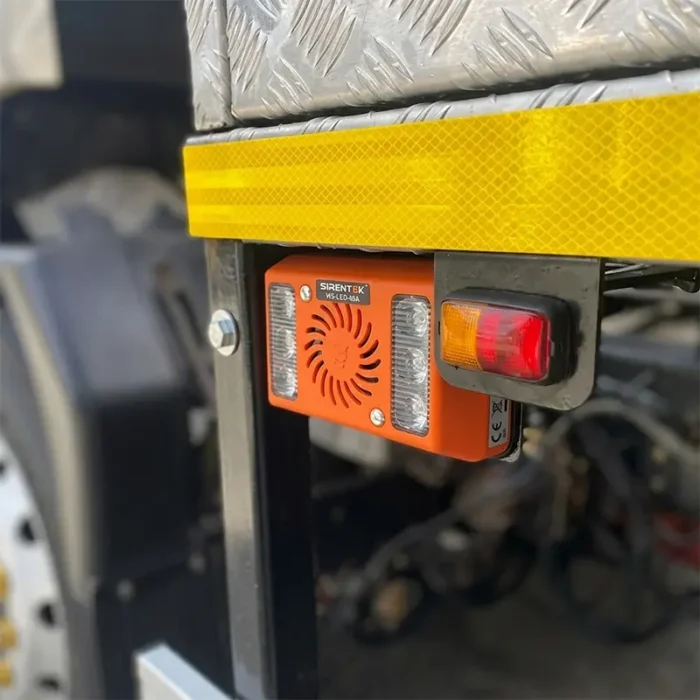
A reversing alarm fitted to a work vehicle to provide an audible warning when the vehicle is reversing.
What Is a Reversing Alarm?
A reversing alarm is an audible warning device designed to alert people around a vehicle or mobile plant when it is reversing.
You may see similar equipment described as a:
- reverse alarm;
- backup alarm;
- audible reversing alarm;
- reverse warning alarm; or
- vehicle warning alarm.
Although the terminology varies, the basic purpose is similar: provide an audible warning to people who may be exposed to a reversing vehicle.
This distinction is important.
A reversing camera primarily gives the driver additional information about what is behind the vehicle. An audible reversing alarm communicates outward to people around the vehicle.
That is why both technologies may form part of the same vehicle safety configuration rather than necessarily replacing one another.
Why Are Reversing Vehicles a Workplace Safety Risk?
Reversing becomes more difficult when vehicles and pedestrians need to share the same operating space.
Blind spots can restrict what a driver can see. Workers may approach from different directions. Noise from machinery can make communication more difficult. Loads, trailers or equipment can further change visibility around a vehicle.
The risk can become particularly important around:
- loading and unloading areas;
- warehouses and depots;
- construction and civil worksites;
- traffic management operations;
- municipal works;
- industrial facilities;
- logistics yards;
- roadside work; and
- locations where mobile plant and pedestrians interact.
The first question therefore shouldn’t always be:
“Which reversing alarm should we install?”
A better starting point is:
“Can we reduce or eliminate the reversing risk first?”
Safe Work Australia recommends eliminating the need for reversing where reasonably practicable. Where reversing cannot be avoided, controls can include cameras, mirrors, sensors, rotating lights, audible reversing alarms, designated reversing areas and keeping non-essential workers away.
This matters because a reversing alarm should not be treated as the entire safety system.
Are Reversing Alarms Required in Australia?
There isn’t a simple blanket answer that applies to every vehicle, workplace and situation across Australia.
Requirements can depend on the type of vehicle or plant, the workplace, applicable WHS laws, the jurisdiction, site-specific requirements and the risks associated with the work being performed.
For example, Safe Work Australia’s construction guidance states that where a powered mobile plant could collide with pedestrians or other powered mobile plants, the plant needs a device to warn people who may be at risk from its movement. The same guidance discusses reversing alarms, cameras, sensors and visual warning devices as potential controls.
WorkSafe WA’s guidance takes an equally useful approach. It notes that Western Australian occupational safety and health legislation does not specifically require tonal reversing alarms; rather, reversing risks need to be addressed through a safe system of work.
So asking:
“Are reversing alarms mandatory in Australia?”
is often less useful than asking:
“What controls are required for this vehicle, workplace and reversing risk?”
Trucks and heavy vehicles
Heavy vehicles often operate around loading areas, depots, worksites and pedestrians. The appropriate controls should be determined for the vehicle and its operating environment rather than assuming every truck requires exactly the same alarm configuration.
Construction vehicles and mobile plant
Construction sites can involve frequent interaction between workers, vehicles and powered mobile plants. Safe Work Australia guidance specifically identifies reversing warning alarms, sensors, cameras and visual warning devices among controls that may be considered.
Commercial work vehicles
Utes, vans, service vehicles and other commercial vehicles may move between depots, public roads, customer sites and active workplaces. The risk environment can therefore change throughout the day.
Council and utility fleets
Municipal and utility fleets can include everything from utes and vans to trucks and specialist vehicles. A single warning configuration may not automatically suit every vehicle in the fleet.
Individual worksites
Site rules may also affect vehicle requirements. Contractors and fleet operators should therefore consider applicable legislation, site procedures and risk assessments rather than relying solely on a general internet answer.
A Reversing Alarm Is Only One Part of the Safety System
Installing a louder alarm does not remove every reversing hazard.
Australian workplace guidance prioritises eliminating risks where reasonably practicable and then working through other control measures. Comcare similarly recommends reducing vehicle-pedestrian interaction and lists warning devices such as flashing lights and audible reversing alarms among possible controls.
A practical reversing-safety approach may therefore involve several layers:
1. Reduce the need to reverse
Drive-through areas, one-way traffic flows and appropriate site design can reduce reversing movements.
2. Separate people and vehicles
Exclusion zones, barriers, pedestrian routes and controlled work areas can reduce interaction.
3. Improve driver awareness
Mirrors, cameras and detection systems may help drivers understand what is around the vehicle.
4. Warn people around the vehicle
This is where audible reversing alarms and visual warning equipment become relevant.
5. Support the equipment with procedures
Training, site rules, supervision and traffic-management procedures remain important.
The right combination depends on the actual risk.
For Australian Warning Systems, this broader approach is particularly relevant because vehicle safety alarm systems Australia is not simply a product-selection issue. Audible, visual and detection technologies can have different jobs within the same vehicle safety configuration.
Reversing Alarm Regulations in Australia: What Should Operators Check?
Reversing alarm requirements are not always the same across every vehicle, workplace or operating environment. The requirements that apply can depend on factors such as the type of vehicle or mobile plant, the work being performed, the workplace, the relevant jurisdiction and any site-specific safety procedures.
For fleet managers, contractors and vehicle operators, this means it is important to look beyond the question of whether a reversing alarm is simply “mandatory”. The more practical approach is to identify the reversing risks involved, understand the requirements that apply to the operation and determine what warning or safety controls are appropriate.
Australian workplace guidance also treats reversing alarms as part of a wider approach to managing vehicle and pedestrian risks rather than as a standalone solution.
If you’re specifically researching the legal and regulatory side, read our dedicated guide to Reversing Alarm Regulations in Australia. It takes a closer look at the requirements and considerations operators should understand when assessing reversing alarms for Australian work vehicles.
What Types of Reversing Alarms Are Available?
Not every reverse alarm produces the traditional “beep-beep” sound.
Different alarm technologies are available for different operating requirements.
| Alarm type | How it warns | What to consider |
| Tonal | Recognisable repeating tone | Traditional audible warning applications |
| Broadband / white noise | Sound spread across a wider frequency range | Direction recognition and noise-sensitive environments |
| Self-adjusting | Output adapts according to surrounding noise | Environments where background noise changes |
| Talking | Spoken warning message | Applications where a voice warning is appropriate |
| Squawker / specialist | Distinctive audible pattern | Specific fleet or operational requirements |
Australian Warning Systems’ Reverse Alarms range includes self-adjusting, specialist, talking, squawker and tonal alarm options, allowing equipment to be considered according to the vehicle and application rather than treating every reversing situation identically.
Tonal vs Broadband Reversing Alarms: What’s the Difference?
A tonal reversing alarm produces the familiar repeating warning tone commonly associated with reversing trucks and plants.
A broadband reversing alarm, sometimes called a white-noise alarm, produces sound over a broader range of frequencies.
The distinction is more important than simply how the two alarms sound.
WorkSafe WA reports that broadband alarms can make it easier to identify where a sound is coming from and distinguish between multiple sources. Its guidance also identifies potential benefits in locations where tonal alarms create environmental noise concerns.
That doesn’t mean broadband should automatically replace tonal alarms in every application.
Consider the actual environment.
A vehicle operating at an isolated industrial site may have different requirements from equipment operating beside residential properties. A truck working in a busy depot may face different background noise from a council vehicle moving between suburban work locations.
The more useful question is therefore:
Which warning characteristic is appropriate for the people, vehicle and environment involved?
What Is a Self-Adjusting Reversing Alarm?
Work vehicles do not always operate in a consistent noise environment.
A vehicle may begin the day in a quiet depot, move onto a busy construction site and later operate around traffic or machinery.
A self-adjusting reversing alarm is designed to respond to surrounding noise conditions rather than relying on one fixed warning output.
WorkSafe WA specifically identifies self-adjustable “smart” alarms as one option when selecting an appropriate output level for the operating conditions.
The exact behaviour and adjustment range will depend on the particular product, so specifications should always be checked before selection.
This type of technology can be particularly worth investigating where operating noise changes considerably throughout the working day.
What Is a Talking Reverse Alarm?
A talking reverse alarm uses a spoken message rather than relying only on a conventional warning tone.
Depending on the product, the message can provide a more explicit indication that a vehicle is reversing or that people should remain clear.
Talking alarms can be considered where a spoken warning suits the particular work environment or fleet requirement.
However, the same selection principle applies:
Don’t choose an alarm simply because its warning is different. Choose it because its warning method suits the application.
AWS’s Reverse Alarms category includes talking alarm options alongside tonal, squawker and self-adjusting systems.
What Type of Reversing Alarm Is Best for Work Vehicles?
There isn’t one alarm type that is automatically the best for every work vehicle.
A better selection process begins with the vehicle’s actual job.
1. What vehicle are you fitting?
Start with the basics.
Is it a:
- truck;
- ute;
- van;
- trailer;
- mobile plant;
- traffic management vehicle; or
- specialist vehicle?
The vehicle configuration influences installation, electrical requirements and how the warning needs to function.
2. Where does the vehicle normally operate?
A commercial vehicle reversing alarm used in an industrial depot may face a very different environment from one used around suburban maintenance work.
Consider whether the vehicle regularly operates around:
construction sites, warehouses, depots, public roads, residential properties, industrial facilities or pedestrian areas.
3. How noisy is the environment?
Background noise is an important selection consideration.
The objective isn’t simply to overpower everything else with the loudest possible alarm. The warning needs to be suitable for the conditions.
4. Are there noise-sensitive surroundings?
Construction and commercial activity can take place close to homes and other noise-sensitive locations.
WorkSafe WA notes that tonal reversing alarms can contribute to community noise complaints and identifies broadband alarms as an option worth considering in such environments.
5. What electrical system does the vehicle use?
Check the individual alarm’s voltage and electrical specifications against the actual vehicle.
Do not assume every vehicle audible warning system Australia product is suitable for every electrical configuration.
6. What output is appropriate?
Higher output isn’t automatically better.
Consider background noise, proximity of workers, the alarm technology and manufacturer specifications.
7. What safety equipment is already fitted?
The vehicle may already use:
- reversing cameras;
- sensors;
- beacons;
- directional warning lights;
- work lights;
- other audible alarms; or
- additional safety systems.
Selection should consider how these technologies work together.
8. Is this one vehicle or an entire fleet?
For one vehicle, the decision can focus closely on that individual application.
For a fleet, consistency, installation, maintenance, replacement equipment and different vehicle groups also become important.
How Loud Should a Reversing Alarm Be?
It is tempting to compare reversing alarms only by decibel rating.
But louder does not automatically mean more appropriate.
The warning needs to be recognisable within the operating environment without treating maximum sound output as the sole measure of safety.
Factors can include:
- ambient/background noise;
- distance from people at risk;
- vehicle size;
- operating location;
- surrounding machinery;
- alarm technology; and
- applicable requirements.
WorkSafe WA recommends choosing an alarm output appropriate to the specific conditions and identifies self-adjusting alarms as one potential option.
This is particularly relevant for fleets that move between environments with very different noise levels.
Where Should a Reversing Alarm Be Installed?
Even an appropriately selected alarm can be compromised by poor installation.
WorkSafe WA recommends positioning reversing alarms at the rear and as close to the centre of the vehicle as possible, while keeping the sound path unobstructed. Its guidance also recommends considering alarms on trailers.
In practice, installation planning should consider:
- the vehicle body;
- equipment that could obstruct the alarm;
- physical protection;
- wiring;
- mounting security;
- access for inspection; and
- the complete vehicle/trailer configuration.
Installation requirements can differ between vehicles and products, so manufacturer instructions and applicable vehicle requirements should take priority over generic mounting advice.
For specialist or fleet applications, professional installation can also help ensure the alarm is considered alongside the vehicle’s other warning equipment.
Reversing Alarm vs Reversing Camera: Do You Need Both?
This question comes up because both technologies deal with the same vehicle movement but from different perspectives.
A reversing camera primarily assists the driver by providing additional visibility behind the vehicle.
A reversing alarm communicates outward by providing an audible warning to people around the vehicle.
A visual warning light provides another external warning channel.
A detection system may identify hazards or objects depending on the technology.
Safe Work Australia and Comcare both identify multiple technologies and controls for managing reversing and vehicle-pedestrian risks rather than treating one device as a universal substitute for all others.
So the decision shouldn’t necessarily be:
Alarm OR camera?
For some applications, the better question is:
What combination of controls appropriately addresses the reversing risk?
Which Reversing Alarm Suits Different Work Vehicles?
Different vehicles create different warning requirements.
Trucks and heavy vehicles
A truck reversing alarm Australia application may involve large blind areas, trailers, loading zones, depots and interaction with workers.
Consider the entire vehicle combination and normal operating environment rather than selecting purely by vehicle size.
Utes and service vehicles
Commercial utes may operate in depots in the morning, beside roads during the day and around customers or pedestrians later.
A work vehicle reversing alarm therefore needs to suit the vehicle’s real operating pattern.
Construction and civil vehicles
Construction environments can combine workers, plant, trucks, changing site layouts and high background noise.
Safe Work Australia specifically identifies alarms, cameras, sensors and visual warning devices among controls that may be considered where mobile plant and people interact.
Traffic management vehicles
These vehicles can operate around live traffic, workers and changing roadside environments. Audible warning equipment should therefore be considered alongside the vehicle’s visual warning and traffic-management equipment.
Council and utility vehicles
These fleets frequently include several vehicle types and operate across different locations.
Rather than forcing one alarm configuration across everything, it can be more practical to establish suitable configurations for different vehicle groups.
Warehousing and logistics
The interaction between vehicles, loading areas and pedestrians becomes particularly important.
Traffic flow, exclusion zones, visibility and warning equipment should be considered together.
Emergency and specialist vehicles
Emergency vehicle alarm systems Australia can involve reversing warnings as one component of a much broader audible and visual warning package.
The complete vehicle configuration matters more than selecting individual components in isolation.
Should Trailers Have Reversing Alarms?
Trailers deserve specific consideration because the rear of the complete vehicle combination can be a considerable distance from the towing vehicle.
WorkSafe WA’s reversing-alarm guidance specifically recommends fitting an alarm to trailers as well.
That does not mean every trailer should be treated identically.
Consider the trailer configuration, operating environment, electrical system, applicable requirements and how the complete combination is used.
Common Mistakes When Choosing a Vehicle Reversing Alarm
A reversing alarm can look like a simple component, which makes it easy to make the selection decision too simple as well.
Choosing only by decibel rating is one common mistake. Sound output matters, but so do alarm characteristics and the environment in which the vehicle works.
Assuming louder always means safer creates the same problem. The objective is an appropriate warning, not simply maximum noise.
Ignoring the normal working environment can result in equipment that looks suitable on paper but is poorly matched to everyday operation.
Using the same solution across every fleet vehicle can overlook differences between utes, trucks, vans, trailers and specialist equipment.
Poor positioning can obstruct the alarm’s sound path.
Ignoring other safety systems misses the opportunity to consider cameras, detection and visual warnings as part of the same safety configuration.
And perhaps most importantly, relying on an alarm as the only reversing control overlooks the wider hierarchy of workplace risk controls recommended in Australian safety guidance.
How Often Should Reversing Alarms Be Tested?
There isn’t one arbitrary inspection interval that should be applied to every product, vehicle and workplace.
Instead, testing and inspection should follow the relevant manufacturer requirements, workplace procedures, operating conditions and fleet maintenance program.
Practical checks can include:
- confirming that the alarm operates correctly;
- inspecting mounting security;
- looking for physical damage;
- checking wiring and connections;
- checking for obstruction;
- identifying changes to surrounding equipment; and
- investigating any change in alarm performance.
WorkSafe WA notes that reversing alarms, like other safety devices, need to be adequately fitted, maintained and used.
For fleet operators, incorporating these checks into existing vehicle inspection processes can be more practical than treating the alarm as an isolated component.
Choosing Reversing Alarms for an Entire Fleet
Selecting one alarm for one vehicle is different from planning vehicle warning alarm systems Australia across a fleet.
For a mixed fleet, begin by grouping vehicles according to their actual application.
For example:
Vehicle type → Operating environment → Reversing risk → Alarm technology → Electrical compatibility → Installation → Inspection
A council fleet may have several different configurations.
A utility ute does not necessarily need the same setup as a heavy truck. A traffic management vehicle may already have extensive visual warning equipment. A vehicle working primarily in residential areas may present different noise considerations from plant operating at an industrial site.
Fleet standardisation can still be useful where vehicles and applications are genuinely similar.
It can simplify:
- purchasing;
- installation documentation;
- replacement parts;
- maintenance;
- operator familiarisation; and
- future vehicle fitouts.
The aim isn’t necessarily to put the same alarm on every vehicle.
It is to create a consistent decision process across the fleet.
Reversing Alarm Selection Checklist
Before choosing a reversing alarm for a vehicle or fleet, work through this checklist.
Vehicle
☐ What vehicle or plant is being fitted?
☐ Is a trailer involved?
☐ What electrical system does it use?
Operating environment
☐ Where does the vehicle normally operate?
☐ How much background noise is present?
☐ Are nearby locations sensitive to noise?
☐ How frequently are pedestrians near the vehicle?
Alarm
☐ Tonal, broadband, self-adjusting, talking or specialist?
☐ Is the output appropriate for the operating environment?
☐ Does the product specification suit the vehicle?
Existing safety equipment
☐ Reversing camera?
☐ Detection system?
☐ Beacons or warning lights?
☐ Directional warning equipment?
☐ Other audible warning systems?
Installation and operation
☐ Can the alarm be positioned appropriately?
☐ Is the sound path unobstructed?
☐ Can wiring be protected?
☐ Can the equipment be inspected and maintained?
☐ Have applicable workplace and site requirements been considered?
For fleet operators, add one more question:
Can this configuration be appropriately standardised across similar vehicles?
Building a More Complete Vehicle Reversing Safety System
A reverse alarm has one important job: providing an audible warning.
But a work vehicle may need to communicate hazards in more than one way.
Depending on the vehicle and application, a wider system can include audible reversing alarms, visual warning lights, cameras, sensors, directional lighting and other vehicle safety equipment.
This is where the conversation changes from:
“Which alarm should we buy?”
to:
“What does this vehicle need to operate appropriately within its working environment?”
Australian Warning Systems supplies a range of vehicle safety alarm systems in Australia, including self-adjusting, tonal, talking, squawker and specialist reverse alarms, alongside wider vehicle warning and safety solutions.
For fleet or specialist vehicle requirements, product selection can also be considered alongside installation and the vehicle’s existing warning equipment.
Final Thoughts
There is no single reversing alarm that is automatically right for every Australian work vehicle.
A tonal alarm may suit one environment. A broadband or self-adjusting system may be worth considering in another. Talking or specialist alarms can serve different operational requirements again.
The decision should begin with the risk, not the product.
Consider where the vehicle operates, who works around it, background noise, vehicle configuration, existing safety equipment and applicable workplace requirements. Then select an alarm whose characteristics suit that application.
Most importantly, don’t treat an audible alarm as the entire reversing-safety strategy.
Australian workplace guidance consistently points toward a broader approach: reduce reversing where reasonably practicable, separate people from vehicles, improve visibility, use suitable warning and detection technologies, and support those measures with appropriate procedures.
For fleet managers, contractors, councils and other commercial operators, that broader approach creates a much better question than simply asking which alarm is loudest:
What warning and safety configuration is appropriate for the way this vehicle actually works?
FAQs
Are reversing alarms required in Australia?
There is no single blanket requirement covering every vehicle and workplace. Requirements depend on the vehicle or plant, workplace, applicable WHS legislation, jurisdiction and identified risks. Australian safety guidance recommends assessing reversing risk and using appropriate controls, which can include audible reversing alarms.
Are reversing alarms mandatory on trucks in Australia?
Not every truck and operating situation should be treated identically. Operators need to consider applicable vehicle, workplace and site requirements and manage the risks associated with reversing. Audible alarms can form part of those controls.
What type of reversing alarm is best for work vehicles?
There is no universally best type. Tonal, broadband, self-adjusting, talking and specialist alarms have different characteristics. Selection should consider the vehicle, operating environment, background noise and warning requirements.
What is the difference between tonal and broadband reversing alarms?
Tonal alarms produce a recognisable single-frequency warning tone. Broadband alarms spread sound across a wider frequency range. WorkSafe WA notes potential localisation and environmental-noise advantages with broadband alarms.
What is a self-adjusting reversing alarm?
A self-adjusting alarm is designed to adapt its output according to surrounding noise conditions. This can be useful where a vehicle moves between environments with different background-noise levels.
How loud should a reversing alarm be?
There isn’t one appropriate sound level for every application. Alarm output should suit the operating conditions and relevant requirements rather than simply being as loud as possible.
Where should a reversing alarm be installed?
WorkSafe WA recommends installing an alarm at the rear and as close to the centre of the vehicle as possible while keeping the sound path unobstructed. Product and vehicle installation requirements should also be followed.
Do I need a reversing alarm if my vehicle has a reversing camera?
The technologies perform different functions. A camera primarily helps the driver see behind the vehicle, while an audible alarm warns people around it. Depending on the risk, multiple controls may be appropriate.
Can reversing alarms be fitted to trailers?
Yes, depending on the equipment and trailer configuration. WorkSafe WA specifically recommends considering an alarm on trailers as part of reversing safety.
How often should a reversing alarm be tested?
Follow the product manufacturer’s requirements and the relevant workplace or fleet maintenance program. The alarm should remain properly fitted, operational and unobstructed, with faults or damage addressed appropriately.