


Programmable LED Message Boards vs Arrow Boards: Which Is Right for Traffic Management?
Traffic management vehicles across Australia have one primary objective: keeping road workers and motorists safe.
Whether it’s a roadworks project on a regional highway, utility maintenance in a suburban street, or emergency traffic control after an incident, the ability to communicate clearly with approaching drivers is critical.
When organisations begin upgrading their fleet safety equipment, one question often arises:
Should we invest in a programmable LED message board or an arrow board?
The answer depends on how the vehicle is used, where it operates, and what information needs to be communicated.
This guide compares programmable LED message boards, arrow boards, and modern traffic message display boards to help councils, contractors, utilities, and traffic management providers choose the right solution.
👉 Related Reading:
Vehicle Message Displays & Traffic Safety Signage in Australia: Complete Buyer’s Guide
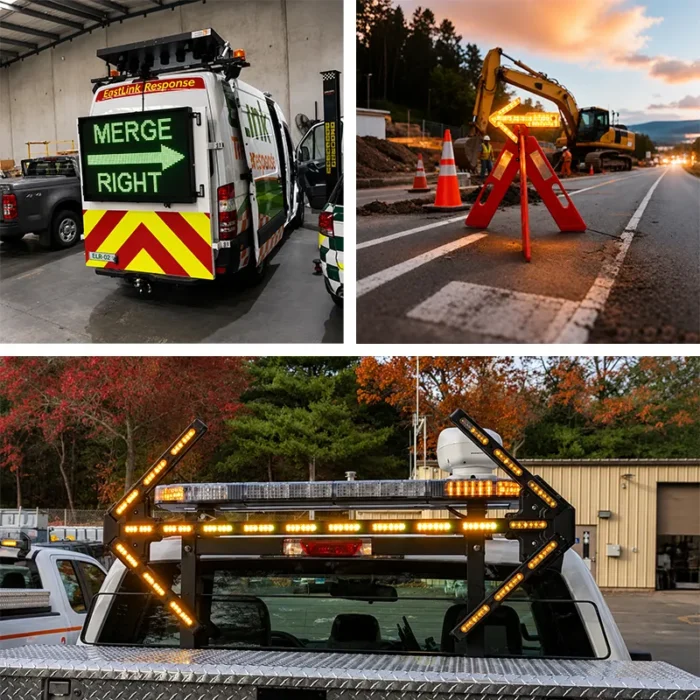
The Real Question Isn’t Which Product Is Better
Many buyers approach this comparison assuming one product replaces the other.
In reality, they serve different purposes.
A traffic management vehicle operating on a high-speed road faces different communication requirements than a council maintenance vehicle working in a suburban street.
Before comparing products, it helps to ask:
What information needs to be communicated?
Do drivers need to:
- Change lanes?
- Merge left?
- Slow down?
- Prepare to stop?
- Be warned about roadworks?
- Follow traffic controllers?
The answer determines whether an LED warning message board, an arrow board, or a combination of both is the best solution.
What Is an Arrow Board?
An arrow board is a traffic control device that uses illuminated arrows to direct vehicle movement.
Most arrow boards are designed to:
- Direct traffic left
- Direct traffic right
- Indicate lane closures
- Guide merging traffic
They are commonly mounted on:
- Traffic management vehicles
- Roadworks trucks
- Utility vehicles
- Incident response units
Arrow boards communicate one thing exceptionally well:
Directional movement.
Drivers immediately understand which way traffic should travel.
Where Arrow Boards Work Best
Arrow boards are highly effective in situations involving:
Lane Closures
Temporary lane closures on highways and arterial roads.
Traffic Diversions
Roadworks requiring motorists to move around an obstacle.
Incident Management
Emergency response vehicles managing traffic around accidents.
High-Speed Environments
Regional highways where drivers need clear directional guidance from a distance.
Because arrows are universally recognised, driver comprehension is almost immediate.
Limitations of Arrow Boards
While arrow boards are excellent directional tools, they have limitations.
They cannot communicate:
- Roadworks Ahead
- Prepare To Stop
- Utility Works
- Traffic Controller Ahead
- Speed Reduction Requirements
An arrow communicates direction but not context.
Drivers may know where to move, but not necessarily why.
This is where programmable LED message boards become valuable.
What Is a Programmable LED Message Board?
A programmable LED message board is a digital display capable of showing customised safety messages.
Unlike arrow boards, these systems provide written communication.
Examples include:
- ROADWORKS AHEAD
- SLOW DOWN
- TRAFFIC CONTROL AHEAD
- PREPARE TO STOP
- WORKERS ON ROAD
- LANE CLOSED
Modern traffic message display boards allow operators to change messaging instantly depending on site conditions.
This flexibility makes them one of the fastest-growing categories within Australian traffic management fleets.
Why Programmable Message Boards Are Growing in Popularity
Traffic management today is more dynamic than ever.
A crew may perform:
- Road maintenance
- Utility repairs
- Emergency response
- Vegetation management
- Inspection activities
all within a single day.
A programmable system allows messaging to adapt accordingly.
Instead of carrying multiple static signs, operators can update instructions instantly.
This improves:
- Safety
- Efficiency
- Fleet utilisation
- Driver awareness
LED Message Board vs Arrow Board: Side-by-Side Comparison
| Feature | Arrow Board | Programmable LED Message Board |
| Direct Traffic Direction | Excellent | Limited |
| Custom Messaging | No | Yes |
| Roadworks Warnings | Limited | Excellent |
| Utility Work Notifications | No | Excellent |
| Lane Closure Guidance | Excellent | Good |
| Flexibility | Moderate | High |
| Traffic Management Applications | Excellent | Excellent |
| Public Information Messaging | No | Excellent |
| Driver Awareness | Good | Excellent |
| Fleet Versatility | Moderate | High |
This comparison highlights why many organisations are moving toward programmable message systems.
LED Message Board vs Arrow Board for Roadworks
One of the most common search questions is:
Message Board or Arrow Board for Roadworks?
The answer depends on the type of roadworks.
Roadworks Requiring Lane Changes
An arrow board is often essential because it clearly directs traffic movement.
Roadworks Requiring Warning Messages
A traffic message display board provides greater flexibility by explaining the hazard.
Examples include:
- ROADWORKS AHEAD
- PREPARE TO STOP
- TRAFFIC CONTROLLER AHEAD
In many situations, both systems work best together.
When Should Traffic Vehicles Use Message Displays?
Another common LLM search query is:
When Should Traffic Vehicles Use Message Displays?
Traffic vehicles should use message displays when drivers need more information than simple directional guidance.
Examples include:
- Utility maintenance
- Council operations
- Temporary traffic control
- Mobile work crews
- Emergency response
- Road inspections
These activities benefit from written communication rather than directional arrows alone.
Why Councils Are Choosing Vehicle Mounted LED Signage
Local governments increasingly deploy vehicle mounted LED signage because councils perform a wide variety of roadside tasks.
A council vehicle may:
- Repair roads
- Maintain drainage
- Manage trees
- Inspect infrastructure
A programmable display allows the same vehicle to support multiple activities.
This improves fleet efficiency and reduces equipment duplication.
Can Arrow Boards and Message Displays Work Together?
Absolutely.
In fact, many of Australia’s most advanced traffic management vehicles use both.
A combined setup may include:
Arrow Board
Directs traffic movement.
Electronic Road Message Sign
Explains why drivers need to take action.
For example:
Message Display:
ROADWORKS AHEAD
Arrow Board:
MERGE LEFT
Together, these systems create a clearer and safer traffic management environment.
Best Traffic Management Signage for Different Applications
Councils
Best option:
Programmable LED Message Board
Reason:
Multiple activities require flexible communication.
Utility Providers
Best option:
Programmable LED Message Board
Reason:
Mobile crews need changing messages.
Traffic Management Contractors
Best option:
Message Board + Arrow Board Combination
Reason:
Maximum flexibility across different projects.
Emergency Response Vehicles
Best option:
Programmable LED Warning Message Board
Reason:
Rapid deployment and changing conditions.
Buyer Checklist Before Choosing
Before purchasing, ask:
What type of work does the vehicle perform?
Do drivers need directional guidance?
Do drivers need written instructions?
Is the vehicle mobile or site-based?
Will messaging change regularly?
Is the vehicle used by councils, utilities, contractors, or emergency services?
The answers will usually identify the correct solution.
Final Thoughts
The debate between programmable LED message boards and arrow boards isn’t really about choosing one over the other.
It’s about selecting the right communication tool for the task.
Arrow boards remain one of the most effective solutions for directing traffic movement.
Programmable LED warning message boards excel at providing information, warnings, and instructions.
For many Australian councils, contractors, utilities, and traffic management providers, the most effective solution is often a combination of both.
The result is clearer communication, safer worksites, and improved traffic control outcomes across Australia’s road network.