


By Australian Warning Systems | Police & Emergency Vehicle Lighting | Australia
Two police vehicles can leave the same fleet workshop with completely different warning-light layouts and both configurations can be right.
A marked patrol SUV may have enough roof space for a full-width lightbar, while another response vehicle may need a slimmer profile because of its body shape, roof equipment or fleet specification. A roof bar can also provide excellent forward warning while the rear spoiler, tailgate or vehicle body changes visibility from behind.
For teams specifying police LED lightbars Australia, the decision should not start with “Which lightbar is brightest?” It should start with the vehicle, authorised warning-light requirements, visibility objectives and how the entire warning system will operate together.
This guide compares conventional roof-mounted and low-profile warning lighting, then looks at rear supplementary lighting, controls, electrical integration and fleet standardisation.
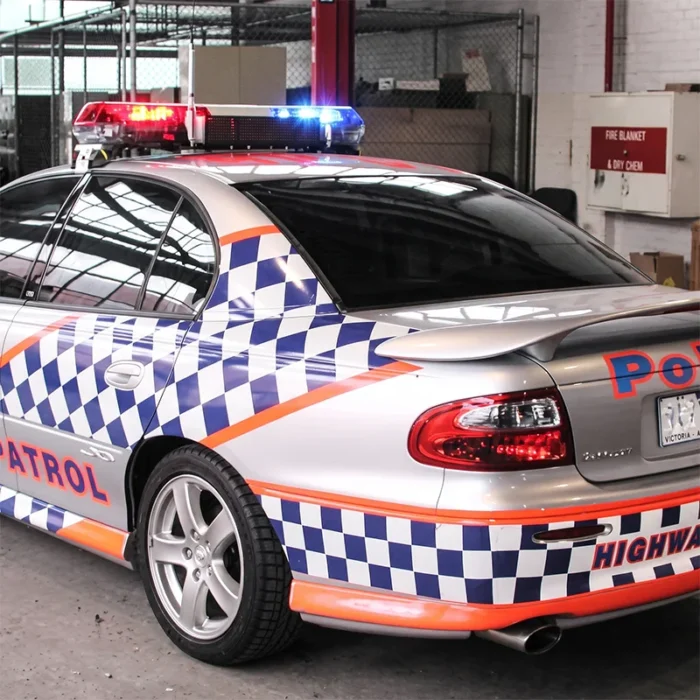
Police vehicle roof lightbars provide emergency warning lighting, with configurations selected for authorised fleet requirements.
Roof-Mounted vs Low-Profile: What Actually Changes?
“Low-profile” describes physical packaging, not automatically better or worse warning performance.
A low-profile lightbar sits closer to the roof and can reduce the visual and physical height of the installation. A conventional full-size bar may provide different optical layouts, internal space, accessory options or mounting configurations.
The right choice depends on the vehicle.
| Specification question | Low-profile design | Conventional/full-size design |
| Roof height | Usually reduces overall installed profile | May add more height depending on model and brackets |
| Vehicle appearance | Can integrate more closely with the roofline | Creates a more prominent roof installation |
| Warning performance | Depends on optics, configuration and mounting | Also depends on optics, configuration and mounting |
| Equipment options | Product-specific | Product-specific |
| Roof obstructions | Must still check aerials, racks and other equipment | Same requirement |
| Fleet suitability | Best assessed vehicle by vehicle | Best assessed vehicle by vehicle |
Fleet buyers comparing roof mounted emergency light bars Australia should therefore avoid treating physical height as a performance rating.
The better question is whether the chosen lightbar delivers the required warning configuration when installed on that particular police vehicle.
Vehicle Shape Should Drive the Layout
A sedan, wagon, SUV and utility-based police vehicle present different warning-light challenges.
A relatively low passenger vehicle may keep the main roof bar visible from several approach angles. A larger SUV can introduce more rear body height and a different spoiler arrangement. Equipment mounted on the roof can alter the available installation position again.
Before choosing from emergency vehicle light bars Australia, map the completed vehicle rather than evaluating an empty roof.
Check:
- usable roof width;
- factory mounting points;
- roof curvature;
- antennas and communications equipment;
- cameras or sensors;
- roof racks where fitted;
- rear spoiler design;
- tailgate or rear-door position;
- final installed height;
- cable-routing options.
The vehicle should also be assessed in its normal operational configuration. A warning system that looks clear in a workshop may present a different profile once all fleet equipment has been installed.
When Does a Low-Profile Police Lightbar Make Sense?
A low-profile design can make sense when the fleet wants to keep roof height controlled, integrate the lightbar more closely with the vehicle or meet a particular fleet fitout specification.
However, buyers should never select a low-profile model solely because it looks cleaner.
Optics matter.
The IONNIC Blade Series sold by AWS, for example, uses a 35 mm-high low-profile housing and offers red/blue configurations alongside other colours. AWS lists SAE Class 1, ECE R10 and ECE R65 approvals, IP67 protection, 10–30V operation and a controller with dimming capability.
AWS also offers the ECCO 1200+ custom platform with multiple colours and configurations, although buyers should confirm the exact model and emergency-vehicle specification rather than assume every 1200+ configuration suits police use.
The point is not that one product automatically becomes the “best police lightbar”. The specification must connect the product’s documented capabilities to the authorised fleet requirement.
When Does a Full-Size Roof Lightbar Make More Sense?
A conventional full-width emergency lightbar can suit fleets that need a highly configurable primary warning system with multiple optical zones and integrated control options.
AWS carries full-size Whelen roof-mounted systems in red, blue, amber and white configurations. The range includes several product families for law-enforcement and emergency use, including low-profile full-size designs such as Legacy as well as other full-size platforms.
The CODE 3 Pursuit Series provides another emergency-focused option. AWS lists lengths from 600 mm to 2100 mm, red/blue and other colour configurations, 10–30V operation, IP66 construction, programmable flash-pattern capability and options such as alley lights, spotlights and siren integration.
Fleet teams researching LED warning light bars Australia should compare these functions against the vehicle specification rather than simply comparing product dimensions.
A larger housing does not automatically mean better warning coverage, just as a lower-profile housing does not automatically mean less warning output.
The Roof Bar Is Not the Whole Warning System
Police warning-light design becomes more useful when fleet teams stop treating the roof bar as a standalone product.
Consider the rear of an SUV. The main roof bar may remain visible from above and from some rear angles, while the spoiler, rear glass geometry or open tailgate changes the visual picture closer to the vehicle.
That creates a different question: does the vehicle need supplementary rear warning lighting?
AWS lists the Whelen Outer Edge rear-spoiler system as a separate rear warning product. It mounts around the rear spoiler, uses dedicated rear-facing lightheads and supports several Whelen control platforms. However, AWS also lists specific vehicle compatibility, so Australian fitters must confirm suitability rather than assume that every local police SUV can accept the same hardware.
This is where searches for rear spoiler light bars in Australia become relevant. The spoiler-mounted system should solve an identified rear-warning requirement; it should not simply become an extra accessory added because the product exists.
Roof Lightbar or Rear Spoiler Lighting? Usually, That Is the Wrong Comparison
Roof and rear-spoiler warning lights do different jobs.
The roof bar acts as the primary elevated warning system in many vehicle configurations. Rear-spoiler lighting targets a more specific rear-facing warning zone.
A procurement team should therefore ask:
What warning coverage does the roof installation provide, and where does the completed vehicle still need additional warning?
For some fleets, the roof system may satisfy the required specification without additional spoiler lighting. On another vehicle, supplementary rear lighting may form part of the approved design.
Buyers looking for rear spoiler light bars Australia should treat those systems as part of a coordinated vehicle package, not as an automatic substitute for the main roof installation.
Red and Blue Warning Lights Require Authorised Use
Police warning-light colours carry specific legal meaning in Australia. They are not general vehicle accessories.
NSW guidance restricts blue or blue-and-red flashing lights to specified authorised vehicles, including police vehicles, ambulances and certain emergency services. It also states that police operational use controls when those warning lights may operate.
Transport Victoria separately recognises police vehicles within its exempt-vehicle framework, while South Australian guidance states that red and blue lights are restricted to emergency vehicles such as police, fire and ambulance vehicles.
These state requirements matter because product availability does not create legal authority.
A red/blue configuration advertised for emergency use should only be supplied and fitted for an authorised application in accordance with the relevant fleet and jurisdictional requirements.
Controller Integration Deserves as Much Attention as the Lightbar
A police vehicle may combine the roof bar with grille lights, rear warning modules, siren equipment, scene illumination and other vehicle electronics.
If each component receives its own unrelated control method, the finished fitout can become unnecessarily complicated.
A fleet specification should define:
- which warning functions activate together;
- permitted flash modes;
- day/night or dimming functions where required;
- supplementary rear-light behaviour;
- siren and warning-light integration;
- controller position;
- diagnostic access;
- service and replacement procedures.
Modern emergency-lighting systems can provide extensive programming options. More functions do not automatically create a better fitout.
Operators need predictable behaviour, and fleet technicians need a configuration they can diagnose and reproduce across multiple vehicles.
This is an important distinction for buyers researching emergency vehicle light bars Australia: the controller and system architecture can affect the quality of the final installation just as much as the lightbar itself.
Check Electrical Requirements Before Approving the Fitout
Police vehicles already carry significant electrical equipment. Communications, cameras, computers, radios and other systems can all share space within the broader vehicle fitout.
Before installation, confirm:
- operating voltage;
- current requirements;
- circuit protection;
- wiring routes;
- controller compatibility;
- accessory loads;
- earthing requirements;
- manufacturer installation instructions;
- access for future servicing.
The CODE 3 Pursuit range, for example, lists 10–30V operation, while the Whelen Outer Edge rear spoiler system currently lists 12V DC. That difference illustrates why fleet teams should evaluate the system as a combination of components rather than assume that every emergency-lighting product shares the same electrical requirements.
Standardise the Specification, Not Necessarily the Physical Layout
Police fleets gain real value from standardisation, but that does not require every vehicle to carry identical hardware.
A better fleet standard defines the outcomes and control philosophy first.
For example:
Patrol sedans: approved roof configuration, controller logic and supplementary warning arrangement.
Patrol SUVs: roof configuration adjusted for vehicle height and rear geometry, with supplementary rear warning assessed separately.
Special-purpose vehicles: lighting layout designed around vehicle-specific bodywork, equipment and operational requirements.
The fleet can then standardise colour configuration, operating modes, controller behaviour, documentation, inspection procedures and approved equipment families while allowing physical variations between platforms.
That approach is stronger than copying the warning-light layout from the previous vehicle generation.
Police Fleet Fitout Checklist
Before requesting quotations for police LED lightbars Australia, give the supplier a proper vehicle specification.
Include:
- Vehicle platform: make, model, year and body type.
- Operational classification: marked patrol, response, specialist or other authorised role.
- Roof layout: measurements plus antennas, sensors and other installed equipment.
- Warning requirement: authorised colours and required warning zones.
- Rear configuration: spoiler, tailgate and potential visibility obstructions.
- Controls: required operating modes and integration with other warning equipment.
- Electrical details: vehicle voltage and relevant fleet electrical specifications.
- Installation: mounting, cable routing and service-access requirements.
- Documentation: product specifications, approvals, wiring information and warranty.
- Fleet repeatability: how the approved setup will be reproduced and maintained.
Australian Warning Systems supplies and installs emergency vehicle warning systems from Hallam, Victoria, with Australia-wide product supply. Its current range includes emergency roof lightbars, supplementary warning products, controllers and related warning-system equipment.
Fleet and authorised vehicle builders can compare the AWS emergency lightbar range or discuss a vehicle-specific fitout with AWS.
The strongest police warning-light specification does not simply choose between “low-profile” and “full-size”. It matches the primary roof system, rear warning coverage, controls and installation to the actual vehicle and authorised operational requirement.
Frequently Asked Questions
Can any vehicle use red and blue police warning lights in Australia?
No. Australian jurisdictions restrict red and blue flashing warning lights to particular authorised emergency and law-enforcement vehicles. Vehicle owners should confirm their authority before purchasing or installing a restricted-colour system.
Are low-profile police LED lightbars less visible than full-size lightbars?
Not automatically. Housing height alone does not determine warning performance. Optics, LED configuration, mounting position, vehicle shape and viewing angles all affect the finished system.
Can rear spoiler warning lights replace a roof-mounted police lightbar?
Do not assume they can. Rear-spoiler lighting usually serves a specific rear-warning function, while the main roof system can serve a broader warning role. The fleet specification should determine how the systems work together.
Why add supplementary rear warning lights to a police SUV?
The vehicle’s roofline, spoiler, rear body or operating configuration may affect visibility from rear and rear-quarter approaches. Fleet teams should assess the completed vehicle and specify supplementary lights only where the approved warning design requires them.
How do you choose the correct police lightbar size?
Start with the vehicle roof width, approved mounting points, roof equipment, body profile and warning-system specification. Product length should follow those requirements rather than using one standard length across every fleet vehicle.
What should be included in a police vehicle lighting quotation?
A complete quotation should identify the lightbar model and configuration, warning colours, mounting hardware, supplementary lighting, controllers, electrical requirements, installation scope, documentation, warranty and any vehicle-specific compatibility requirements.