


The warning lightbar looks suitable. The supplier has confirmed the price. Your workshop can fit it next week. But there’s one problem: nobody has checked whether the mine will accept the equipment.
Imagine a Victorian mining contractor preparing six service utes for a new site. The buyer orders identical amber lightbars, assuming they will satisfy the site’s requirements. When the contractor reviews the vehicle-entry specification, it discovers that the site also requires particular mounting arrangements, documented environmental protection and additional safety equipment.
The fleet now needs changes before it can start work.
It’s a hypothetical situation, but the purchasing mistake is easy to understand. Mining vehicle warning lights Australia buyers select must satisfy more than a catalogue description. They must suit the vehicle, its operating environment and the mine operator’s actual requirements.
So, before approving the purchase order, what should you ask?
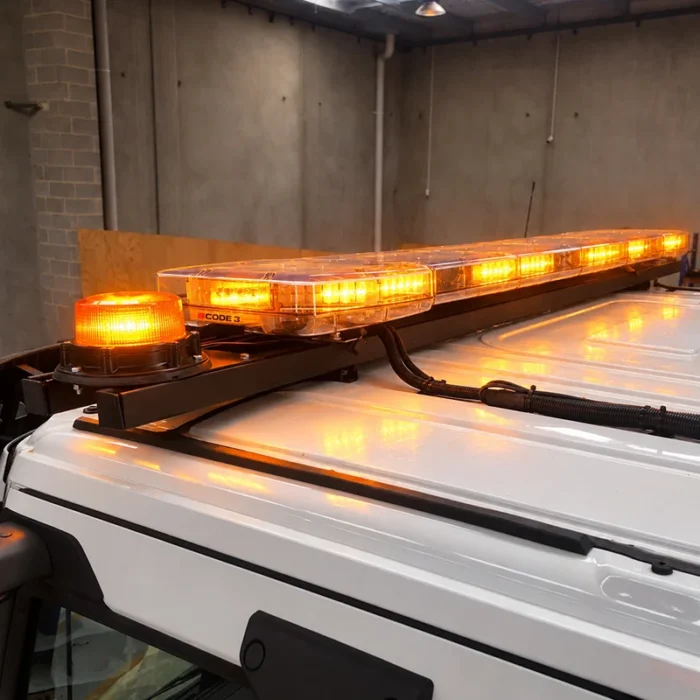
Amber warning lighting helps identify tow trucks during roadside recovery and vehicle loading operations.
The First Document Should Come From the Mine, Not the Supplier
People often describe a vehicle as “mine spec” without identifying which mine’s requirements it meets. That creates uncertainty because Australian mining operators do not all use an identical warning-light specification.
An open-cut operation, underground mine, quarry and mineral-processing facility can have different vehicle-access arrangements. Individual operators may also apply additional conditions to contractors and visiting vehicles.
A contractor working across Victoria, New South Wales and South Australia should never assume that approval at one site guarantees approval at another.
The starting point is the site’s current vehicle-entry documentation. Ask the relevant site representative to identify the required warning-light colour, mounting location, operating conditions and any supporting test evidence.
Also confirm which rules apply when the vehicle travels on public roads. Site approval and road-use permission are separate considerations.
If the requirements are unclear, resolve them before ordering. A written clarification costs considerably less than modifying an entire fleet after installation.
Three Vehicles, Three Different Purchasing Decisions
Consider a fictional contractor fleet containing a dual-cab maintenance ute, a service-body truck and a supervisor’s light vehicle. All three need to enter the same mining operation, but their physical configurations create different installation questions.
The maintenance ute carries a roof rack, mine flag, UHF aerial and tools. The available mounting area is limited, and accessories may affect how other vehicle operators see the warning signal.
The service-body truck has a higher roof and larger equipment compartments. Its electrical system and mounting requirements may also differ from those of the ute.
The supervisor’s vehicle has a simpler body arrangement, but the site may still specify particular warning equipment for its operating role.
| Vehicle | Main issue to resolve | Information the supplier needs |
| Maintenance ute | Racks and accessories near the warning lights | Roof photographs, mounting space and accessory layout |
| Service-body truck | Body height and electrical configuration | Vehicle dimensions, voltage and normal equipment position |
| Supervisor vehicle | Required site-entry configuration | Vehicle classification, approved warning functions and site specification |
This is why mining vehicle LED lightbars should be selected by vehicle application instead of ordering one product across the fleet without fitment checks.
The products may ultimately be identical. The assessment should not be.
A Lightbar and a Minebar Are Not the Same Purchase
Here’s a decision that can change the entire quotation.
Does the site require an amber warning signal, or does it expect an integrated safety bar containing several vehicle functions?
A conventional LED warning lightbar primarily provides visual warning. Some models also offer optional work lights, alley lights or traffic-direction functions.
A dedicated minebar may combine an amber beacon with rear stop, tail, indicator and reversing lamps, work lights and a reversing alarm. Its actual functions depend on the model.
For example, Australian Warning Systems offers IONNIC minebars with integrated warning and vehicle-lighting equipment. That makes them relevant when a site specification calls for several functions in one assembly.
However, a minebar should not replace properly positioned original vehicle lights without an approved design and verification.
Conversely, buying a standard amber lightbar when the site expects additional equipment can leave the contractor with an incomplete fitout.
The difference matters when comparing commercial emergency light bars Australia suppliers offer. More functions are not automatically better; the correct functions are the ones the vehicle and site actually require.
Compare AWS minebar configurations before deciding whether a standalone warning lightbar is sufficient.
What Happens After the Vehicle Leaves the Workshop?
A product may look excellent under workshop lighting. Its real operating environment tells a different story.
Imagine the maintenance ute travelling over corrugated access roads during a dry summer shift. Dust collects on the housing and lens, vibration acts on brackets and wiring, and the vehicle regularly encounters different weather conditions.
The buyer needs evidence that the selected equipment suits those exposures.
Dust and water ratings need documentation
Ask for the manufacturer’s ingress-protection information and compare it with the site’s requirement. An IP rating describes performance under defined tests; it does not automatically guarantee resistance to every cleaning method or operating condition.
Do not assume that a product described as rugged has a particular IP rating.
The AWS ECCO 1200+ standard product page lists its aluminium chassis, polycarbonate lens and operating specifications, but it does not currently publish a specific IP rating. If a site requires documented ingress protection, obtain the relevant manufacturer evidence before purchasing.
Vibration is an installation question, too
A durable lightbar housing cannot compensate for unsuitable brackets or poorly supported wiring.
Confirm the approved mounting hardware, vehicle attachment points and any vibration or shock evidence required by the site. Also check whether the installer can access mounting fasteners and electrical connections during servicing.
For high visibility emergency light bar applications, dependable operation depends on the entire installation, not just the LEDs.
The Visibility Problem That Product Photos Cannot Show
A catalogue image usually shows the lightbar without the vehicle that will carry it.
That can hide a critical issue.
Roof racks, service bodies, mine flags and mounted equipment may obstruct warning lights from certain approaches. A lightbar positioned prominently above the windscreen may be less visible from the rear or a quarter angle.
Assess the vehicle with its normal equipment fitted. Check the relevant viewing directions and compare the result with the site’s warning-visibility requirements.
If the vehicle has an identified visibility gap, consider whether changing the mounting arrangement or adding approved supplementary lighting addresses it.
Do not assume a longer lightbar automatically solves the problem.
Warning lighting also forms just one part of vehicle interaction management. Mine operators must consider traffic separation, communications, operating procedures and other appropriate controls. An amber lightbar cannot replace these measures.
Comparing Products: Look Beyond the Specification Headline
A buyer might shortlist an ECCO 1200+ warning lightbar and an integrated minebar because both appear suitable for commercial vehicles.
Their specifications serve different decisions.
| Evaluation point | ECCO 1200+ standard lightbar | Integrated minebar |
| Main function | Roof-mounted LED warning signal | Multiple functions according to configuration |
| Optional equipment | Controllers, work/alley lights and other listed options | May combine beacon, rear lamps, work lights and alarm |
| Voltage | Published 12–24V range | Check the exact minebar model |
| Size and mounting | Select from available lengths and suitable brackets | Assess complete crossbar and installed height |
| Environmental evidence | Request any rating required but not published | Check ratings for the exact components |
| Best purchasing question | Does this warning bar meet the specified need? | Does the site require an integrated equipment package? |
The ECCO 1200+ standard range lists a low-profile housing, several lengths and selectable warning patterns. These features may support certain industrial vehicle applications, but they do not prove automatic mine-site acceptance.
For buyers researching 1200 series LED light bars Australia, the relevant next step is to compare the chosen model with the site’s documented requirements.
Review ECCO 1200+ specifications rather than relying solely on general descriptions of heavy-duty performance.
Before Signing the Purchase Order, Ask for Evidence
A useful supplier quotation should show what the business will receive and what still needs confirmation.
Suppose a contractor is comparing two proposals. One identifies the exact model, mounting hardware, controller, electrical requirements and supporting documents. The other simply describes a “mine-spec LED bar”.
The first gives procurement and safety personnel a stronger basis for evaluation, even if its initial price differs.
Request the manufacturer’s product specification, relevant ratings or approvals, mounting instructions, electrical details, warranty information and a clearly itemised installation scope.
Record the site’s response to any outstanding requirement. Where a particular document or approval is essential, hold the order until someone verifies it.
This creates a traceable purchasing decision rather than an assumption that equipment will gain approval after installation.
The Trial Vehicle Is Your Most Useful Procurement Test
Before fitting an entire fleet, consider approving one representative vehicle from each major vehicle group.
The installer can confirm mounting, installed height, warning visibility, controller operation and electrical integration. The contractor can then arrange the required site inspection and record any changes before approving the remaining fitouts.
This matters when vehicles have different roofs, service bodies or electrical systems.
Fleet managers should also retain installation drawings, product details and maintenance instructions. Drivers need an established pre-start process for reporting damaged lenses, loose mounts and abnormal operation, while workshops need access to replacement components.
A successful trial does not remove the need to inspect individual vehicles, but it can reduce repeated specification errors.
A Better Quote Starts With a Better Fleet Brief
Australian Warning Systems supplies industrial warning lightbars, minebars and related vehicle safety equipment, with installation services available from its Hallam, Victoria facility.
If you’re sourcing mining vehicle warning lights Australia, provide the site’s current requirements, your vehicle list, roof or body photographs, electrical information and any mandatory equipment documents.
That helps the supplier recommend a suitable configuration or identify where further information is needed.
Request a mining fleet equipment quotation and explain what the vehicles must do on site.
The best purchasing decision is not the lightbar with the longest feature list. It’s the equipment package you can justify against the vehicle, the environment and the mine’s actual requirements.
Frequently Asked Questions
Are mine-spec warning lights the same across Australia?
No. Mine operators may apply different equipment specifications, vehicle-entry requirements and approval procedures. Contractors should obtain the current requirements for each site before purchasing warning lights.
Does a mining ute need a lightbar or a minebar?
That depends on the site’s specification. A lightbar mainly provides visual warning, while an integrated minebar may include beacons, rear vehicle lamps, work lights and a reversing alarm. Choose the configuration that meets the documented requirements.
What IP rating should mining vehicle warning lights have?
The required protection depends on the site, operating environment and product application. Request the site’s required rating and the manufacturer’s supporting documentation rather than assuming every heavy-duty product provides the same protection.
Can one LED warning lightbar be used across a mining fleet?
Possibly, but vehicle dimensions, mounting arrangements, electrical systems and operating roles can differ. Assess representative vehicle groups and verify the proposed configuration before placing a fleet-wide order.
Is the ECCO 1200+ automatically suitable for mining vehicles?
No. Its published features may make it suitable for consideration, but the buyer must verify the exact model, environmental requirements, mounting, electrical compatibility and relevant site approvals.
What should a mining contractor send when requesting a warning-light quote?
Provide the current site vehicle standard, vehicle make and model, operating role, electrical details, roof photographs, required warning functions and any mandatory equipment documentation. These details help the supplier prepare a more accurate proposal.