


A council inspection ute, a service-body vehicle and a road-maintenance truck may all display amber warning lighting—but giving all three the same roof lightbar can create the wrong specification. The vehicle’s job, body shape, worksite position and traffic-control role should decide the warning-light setup.
For fleet managers comparing LED warning light bars Australia, the useful question is not “Which bar is brightest?” It is: “What does this vehicle need other road users to recognise, and from which directions?”
This guide takes a fleet-first approach for councils, road-maintenance contractors and utilities in Victoria, New South Wales and South Australia.
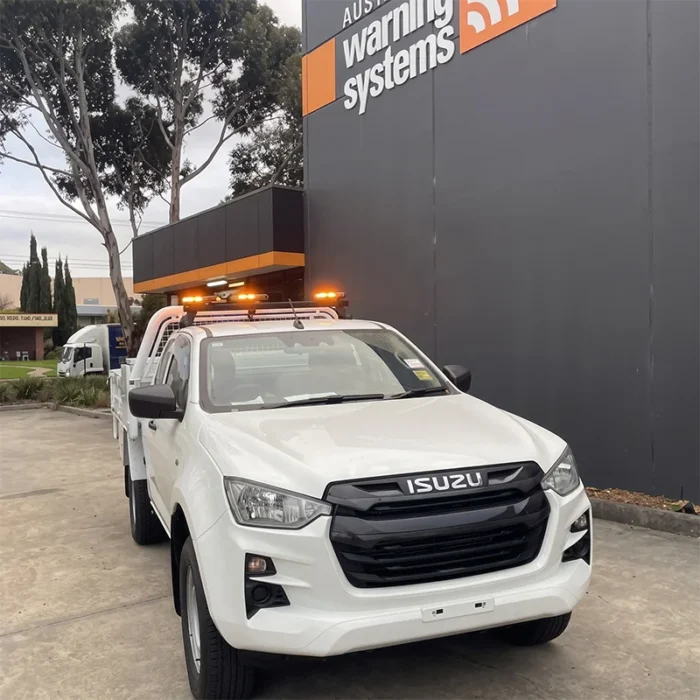
Vehicle role, visibility and worksite requirements should guide warning-light selection across a council fleet.
Start With the Vehicle’s Job, Not the Catalogue
Council fleets work in very different conditions. An inspection ute may stop briefly beside a suburban road, while a service-body utility may spend hours at a repair. A road-maintenance truck may move slowly through a work area or support mobile works.
Before choosing equipment, record what the vehicle does, where it works, how long it remains exposed to traffic, what equipment can obstruct its warning signal and whether it forms part of a formal traffic-management arrangement. This is the right starting point for council vehicle warning lights.
Four vehicle groups need four different questions
Inspection and maintenance utes usually carry roof racks, ladder racks, aerials or toolboxes. Fleet managers need to consider mounting space, clearance and whether accessories obstruct the warning signal.
Service-body utilities create a different challenge. A tall canopy or service body may reduce rear or rear-quarter visibility even when approaching traffic can clearly see the roof lightbar from the front.
Road-maintenance trucks need a complete fitout assessment. Larger bodies, work equipment and additional electrical accessories can affect mounting, controller location, cable routing and access for servicing.
Dynamic-work or convoy vehicles need the clearest separation of all. A roof lightbar attracts attention to the vehicle, but it does not automatically perform the job of a flashing arrow sign, variable message sign or another device required by a traffic-management plan.
That distinction can prevent an expensive specification mistake.
A Lightbar, Flashing Arrow Sign and Work Light Do Different Jobs
Road-maintenance fleets often use several lighting and signalling systems, and they are not interchangeable.
An amber roof lightbar alerts approaching road users to the presence of a work vehicle or plant. A flashing arrow sign tells traffic which direction to pass when a lane closure or diversion requires that instruction. A work light illuminates the area where crews perform their tasks.
Transport for NSW’s Traffic Control at Work Sites manual treats these devices separately. It identifies illuminated flashing arrow signs primarily for situations involving lane closures or traffic diversions and provides separate requirements for vehicle-mounted warning lamps. The manual also allows LED lightbars or beacons for relevant roadwork warning applications when they meet its stated flash-cycle performance condition.
References & Official Sources: Transport for NSW
A feature-rich LED lightbar therefore does not automatically replace another traffic-control device required for the job.
That is an important procurement point. Fleet managers should list traffic-control equipment separately from vehicle warning lights when preparing a specification.
Victoria Gives Fleet Managers a Useful Visibility Benchmark
Transport Victoria identifies vehicles used for road construction, maintenance or repair work in hazardous positions as examples of special-use vehicles that may carry yellow flashing or rotating warning lamps.
Its guidance requires operators to mount at least one correct-colour warning lamp on top of the vehicle so that people can see it in normal daylight from every direction at a distance of at least 200 metres. If one warning lamp cannot provide that coverage, the vehicle needs additional correct-colour lamps.
References & Official Sources:Transport Victoria
Transport Victoria generally restricts yellow flashing or rotating lamps to stationary operation. However, it allows their use while a vehicle moves when road-maintenance work requires frequent stopping, along with several other specified situations.
References & Official Sources: Transport Victoria
For a Victorian fleet buyer, this creates a practical question: can approaching road users see the installed warning system around the actual vehicle body and equipment?
That is why amber warning light bars Australia should not be selected by housing length alone. Use the same visibility-first approach when comparing vehicle warning light bars Australia for different fleet classes.
South Australia Shows Why Vehicle Roles Must Stay Separate
South Australia introduced a 25 km/h rule from 19 May 2025 for motorists passing stationary breakdown-service vehicles displaying flashing amber lights.
However, South Australian road-safety guidance specifically excludes construction vehicles and similar machinery, as well as vehicles performing planned activities with road-authority approval, from that breakdown-service rule.
References & Official Sources: THINK! Road Safety
A council road-maintenance vehicle therefore should not be described as creating the same passing-speed rule simply because it displays amber warning lights.
That distinction matters when a buyer compares amber warning light bars Australia for council fleets rather than breakdown-service vehicles.
Always start with the vehicle’s exact role and then confirm the relevant road rule, road-authority requirement and traffic-management arrangement.
When Should a Roof Lightbar Be Supplemented?
A roof location raises the warning signal above much of the vehicle, but vehicle bodywork and equipment can still create visibility gaps.
Before ordering roof mounted light bars Australia for a mixed fleet, inspect each representative vehicle in its normal working configuration.
Fit or account for the usual:
- roof racks;
- ladders and ladder racks;
- service bodies and canopies;
- aerials;
- mounted equipment;
- worksite signs or other permanent accessories.
Then consider how approaching road users would see the warning system from the front, rear and both sides.
A tall service body may block a rear-quarter view. Ladder racks may cross the lightbar’s line of sight. Equipment mounted above cab height may create another obstruction.
The answer is not automatically “add more lights”. Identify a genuine visibility gap, then assess whether supplementary warning lighting is required.
This produces better vehicle warning light bars Australia specifications because every component has a defined purpose.
Where the ECCO 1200+ Series May Fit
Australian Warning Systems lists the ECCO 1200+ Series as a low-profile 12–24V LED lightbar range.
The standard product range includes 1220mm, 1370mm, 1525mm and 1830mm lengths, high-intensity amber LED modules and 48 selectable flash patterns. Optional features include work or alley lights, in-cab controllers and an integrated Safety Director with an advanced controller.
The product should follow the vehicle assessment, not drive it.
For example, do not specify work lights merely because the option exists. First establish whether the vehicle actually needs additional illumination around a work area.
Likewise, a 12–24V rating does not remove the need for an installer to check switching, wiring, circuit protection, controller integration and connected accessories.
Fleet buyers can review the ECCO 1200+ Series or compare the AWS warning-lighting range without forcing the broad category keywords into internal-link anchor text.
Standardise the Fleet Without Forcing Every Vehicle Into One Setup
Good standardisation reduces parts and installation complexity. Poor standardisation gives different vehicles the same equipment even when their roles do not match.
A better method uses approved fitout classes.
Class A – Inspection and maintenance utes
Develop a standard around similar roof layouts, vehicle dimensions and operational requirements.
Class B – Service-body and utility vehicles
Allow for different mounting positions or supplementary warning lighting where the body or equipment affects visibility.
Class C – Road-maintenance and dynamic-work vehicles
Assess the warning-light installation alongside the vehicle’s traffic-control equipment and worksite role.
Within each class, standardise warning colour, flash-pattern policy, controller logic, wiring records and maintenance. Allow controlled variation in lightbar length, brackets and supplementary equipment where the vehicle or task requires it.
This gives council vehicle warning lights a repeatable procurement structure without pretending every vehicle performs the same job. It also prevents buyers from treating roof mounted light bars Australia as a one-size-fits-all fleet purchase.
A Practical Fleet Quotation Checklist
Before requesting a quote, prepare one specification sheet for each vehicle class.
Include:
- Vehicle details: make, model, year, roof type and electrical system.
- Work role: inspection, utilities, maintenance, construction or mobile works.
- Normal equipment: photograph the vehicle with roof and body equipment installed.
- Visibility requirement: identify the directions from which other road users may approach.
- Separate systems: list flashing arrow signs, VMS equipment and work lights independently.
- Controls: define controller functions, switching logic and required installation documentation.
- Compliance: confirm applicable state rules, traffic-management plans and internal fleet requirements.
This process gives the supplier enough information to recommend a complete setup rather than simply pricing a particular lightbar.
It also helps procurement teams compare quotations properly because brackets, controllers, installation work and supplementary warning equipment can significantly change the actual scope.
Maintenance Belongs in the Original Specification
Road-maintenance vehicles face vibration, dust, rain and regular changes to roof-mounted equipment. Treat serviceability as a buying criterion.
Define how drivers will check the warning system, how crews will report faults and how workshops will record controllers, wiring, brackets and supplementary lighting.
Australian Warning Systems also lists vehicle-specific hook kits for the ECCO 1200+ Series. AWS notes that hook kits do not exist for every vehicle, which makes the vehicle make and model important before ordering equipment.
A good fleet specification should also preserve installation records. When a vehicle later needs repairs, replacement equipment or a fitout change, the workshop should know exactly what the fleet originally installed.
Ask a Better Question Before You Buy
The right question is not:
“Which lightbar should our council buy?”
It is:
“What warning-light specification should each vehicle class meet?”
That difference prevents a fleet from over-specifying a small inspection ute while under-specifying a larger maintenance vehicle.
When comparing LED warning light bars Australia, councils and contractors should begin with the vehicle task, verify warning visibility, separate lightbars from traffic-control and work-light functions, confirm applicable requirements and only then select the product and installation.
Australian Warning Systems supplies roof-mounted warning lighting and related vehicle safety equipment for commercial and fleet applications.
Fleet teams can view suitable warning-lighting options or send AWS their fleet requirements to discuss vehicle-specific fitouts.
The most useful fleet quotation should not simply tell you how many lightbars to buy. It should explain why each vehicle group needs the proposed configuration.
Frequently Asked Questions
Do all council road-maintenance vehicles need an amber roof lightbar?
Not automatically. The suitable warning setup depends on the vehicle’s role, jurisdiction, traffic-management controls and organisational requirements. Fleet managers should confirm the applicable requirements before standardising equipment across several vehicles.
Can an LED warning lightbar replace a flashing arrow sign on a roadworks vehicle?
No. A warning lightbar and an illuminated flashing arrow sign perform different functions. Transport for NSW treats flashing arrow signs as traffic-direction devices and provides separate requirements for warning lamps. A fleet should not use a lightbar as a substitute where a traffic-management arrangement requires another device.
Can amber warning lights operate while a road-maintenance vehicle is moving in Victoria?
In specified circumstances. Transport Victoria permits yellow flashing or rotating warning lamps while a vehicle performs road-maintenance operations that require frequent stopping, subject to the applicable conditions.
References & Official Sources: Transport Victoria
When does a maintenance truck need supplementary warning lights?
Consider supplementary warning lighting when bodywork, racks, equipment or the vehicle’s operating position prevents the primary warning lamp from achieving the required visibility. Assess the actual vehicle first rather than automatically adding additional lights.
Can a council use the same lightbar specification on utes and trucks?
A council can standardise common elements, but one physical configuration may not suit every vehicle. Roof space, body height, electrical systems, mounted equipment and work roles differ. Grouping similar vehicles into approved fitout classes usually creates a better fleet standard.
What information should a council provide when requesting a fleet quote?
Provide the vehicle make, model and year; roof and body configuration; electrical system; permanent equipment; work application; operating environment; existing warning devices; required functions; and any relevant traffic-management or organisational specifications.