


Directing a vehicle sounds simple until the driver cannot clearly see the person giving the signal. Darkness, approaching headlights, rain, busy worksites, parked machinery and other visual distractions can all make ordinary hand signals harder to recognise.
This is where an LED traffic wand in Australia can provide a practical visual aid. Instead of relying only on an unilluminated hand movement, a traffic controller or vehicle marshal can use an illuminated handheld device to make a directional signal easier to identify in suitable working conditions.
Traffic wands are used across roadworks, construction sites, car parks, events, emergency-response environments and other areas where vehicles need to be guided or managed. Australian suppliers commonly describe these products as LED traffic wands, traffic control wands, traffic batons and traffic marshalling wands, so buyers will often encounter several names for equipment that performs a similar general function.
The important question is therefore not simply what the product is called. Buyers should look at how the wand will be used, its visibility, light modes, construction, power source, handling and suitability for the intended traffic-management environment.
This guide covers those considerations and explains how to choose and use a traffic control wand in Australia as part of a broader traffic and vehicle-management system.
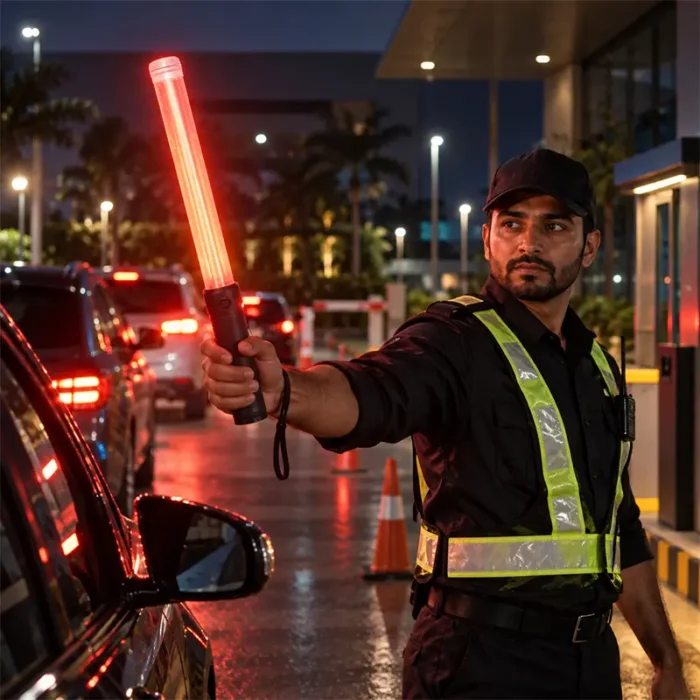
Handheld LED traffic wand designed to provide a visible signalling aid for traffic control, roadworks, vehicle marshalling and suitable low-light applications.
What Is an LED Traffic Control Wand?
An LED traffic control wand is a handheld illuminated signalling device used to make a person’s directions more visible to drivers, operators or other people within a managed area. Its elongated illuminated section creates a larger visual signal than a normal hand gesture, which can be particularly useful after dark or in other low-light environments.
Depending on the product, the wand may provide flashing, steady or guide-light functions. Designs can also include wrist straps, magnetic bases, belt clips or different battery arrangements.
The AWS Hand Held Colour Traffic Wand, for example, uses 19 split-colour LED modules and offers red, blue, red/blue, rapid red/blue and white guide-light functions. Its construction includes a 2 mm impact-resistant polycarbonate lens, ABS handle, wrist strap and a magnet in the base cap. It measures 370 mm by 40 mm and weighs approximately 300 grams.
These features illustrate why an LED traffic control wand in Australia should be selected according to its intended application rather than simply by choosing the brightest-looking product.
Traffic Wand, Traffic Baton or Marshalling Wand: Is There a Difference?
Australian buyers may see similar products described as a traffic wand, traffic control baton, LED traffic baton or traffic marshalling wand. These terms are often used for closely related handheld illuminated signalling products rather than representing completely separate equipment categories.
For example, Australian suppliers currently market comparable illuminated products as an “LED Traffic Marshalling Wand”, “Traffic Wand”, “Traffic Control Wand” and “traffic baton”.
Because terminology varies, purchasing based only on the product name can be misleading. Someone searching for a traffic control baton in Australia may be looking for essentially the same type of handheld signalling equipment as someone searching for a traffic wand.
It is more useful to compare the actual specifications. Look at the available light functions, colour, physical dimensions, power source, handle design, construction, carrying or mounting options and the environment for which the product is intended.
For professional users, those practical differences matter far more than whether a supplier calls the product a baton or a wand.
Why LED Visibility Matters During Traffic Management
Traffic management depends on drivers being able to recognise instructions early enough to respond appropriately. During daylight and in controlled environments, an operator may have several ways of communicating with an approaching vehicle. At night, the visual environment changes considerably.
Headlights can create glare. Work vehicles may have their own warning lights operating. Street lighting can be inconsistent, and a worksite may contain reflective signs, machinery and other illuminated equipment competing for the driver’s attention.
An illuminated traffic wand in Australia provides a clearly visible light source associated with the operator’s hand movement. This can make the signalling action easier to identify in suitable low-light applications.
That does not mean an LED wand replaces the rest of the traffic-management system. Where signs, barriers, cones, STOP/SLOW devices, high-visibility clothing or other controls are required, an illuminated wand should be considered alongside those measures rather than as a substitute for them.
The purpose of the wand is to improve the visibility of an appropriate signalling action, not to replace the planning and controls required to manage vehicle movements safely.
How Does an LED Traffic Wand Work?
Most handheld LED traffic wands are relatively straightforward to operate. LEDs illuminate a translucent or coloured section of the baton, producing a visual signal that can be seen by the person being directed.
The exact functions vary considerably between products. Some Australian traffic wands offer a simple flashing and constant-light mode, while others include a torch function or several flash patterns.
The AWS Hand Held Colour Traffic Wand has a different configuration. It provides five listed functions: red flash, blue flash, red/blue flash, red/blue rapid flash and a white guide light.
Having multiple functions can provide flexibility, but users should not assume that every available colour or pattern is appropriate for every application. The intended use of particular warning colours can be subject to operational, road and jurisdictional requirements. Organisations should therefore determine which functions are appropriate for their work rather than treating every available mode as interchangeable.
Flashing Light and Guide Light Serve Different Purposes
A flashing function is useful because changing light naturally attracts attention. This is one reason a flashing traffic wand in Australia can be useful in environments where an operator needs to be readily identified among surrounding lights and activity.
A guide-light function serves a different purpose. Rather than simply creating an attention-getting flash, it can provide illumination for an appropriate guiding or signalling task, depending on the design of the particular product.
This distinction is worth considering when buying equipment. A work crew that mainly needs a visible flashing signal may have different requirements from a team that also wants an additional guide-light function.
The appropriate choice should therefore be based on how the equipment will actually be used rather than on the number of flash modes printed on the specification sheet.
Where Are LED Traffic Wands Used in Australia?
One reason traffic wands remain useful is that the basic requirement—making a human signal easier to see—appears across many industries.
The AWS product is currently described for applications including roadwork, events, emergency response, security, airports, construction zones, car park marshalling, crowd management and safety patrols. Other Australian suppliers similarly position traffic wands for roadworks, detours, car parks, events, construction and emergency situations.
How the device is used should still reflect the particular workplace and traffic-management arrangement.
Roadworks and Traffic Management
Roadwork environments can involve moving vehicles, workers, temporary lane arrangements and changing conditions. At night or during poor visibility, making the person providing an authorised signal clearly identifiable becomes particularly important.
A roadwork traffic wand can provide an illuminated signalling aid where its use is appropriate to the traffic-management arrangement. It can make the operator’s hand movement more visible, particularly when viewed against a dark background.
However, a wand should not be treated as a replacement for required traffic-control signs, devices, barriers or other controls. It performs a particular signalling role within the wider traffic-management setup.
Construction Sites
Construction sites frequently have vehicles moving through areas that were not designed as permanent roads. Delivery trucks may enter and leave the site, plant may cross vehicle routes, and workers may need to guide vehicles through restricted areas.
A construction traffic wand can be useful when an authorised worker needs to provide a clear illuminated visual signal in suitable conditions.
The physical environment should influence product selection. Equipment used regularly on construction sites may be exposed to knocks, dust and frequent handling, making construction quality, grip and storage important considerations.
Vehicle Marshalling and Loading Areas
Vehicle marshalling often takes place where space is limited. Trucks may need to reverse into loading areas, service vehicles may need to approach designated positions, or drivers may need guidance around equipment and structures.
A traffic marshalling wand in Australia can make the marshal’s signals more visible to the driver, particularly during early-morning, evening or indoor operations.
The wand does not remove the need for agreed procedures. Drivers and marshals should understand the signalling method being used so that an illuminated movement has a clear meaning rather than creating additional confusion.
Car Parks and Events
Large events can create temporary vehicle movements that are very different from normal road conditions. Drivers may be entering unfamiliar parking areas, following temporary routes or leaving venues after dark.
An illuminated traffic wand for car park management can help personnel become easier to identify while directing vehicles through appropriate controlled areas. Similar products are marketed in Australia for car parks, concerts, sporting events and festivals.
Clear procedures remain important because drivers may be unfamiliar with the site and may already be distracted by pedestrians, other vehicles and temporary signage.
Emergency and Roadside Environments
Visibility can also matter during emergency or roadside response. A suitable emergency LED traffic wand in Australia may provide an additional illuminated signalling tool where personnel need to manage or guide vehicles.
An emergency traffic control wand in Australia should still be treated as one component of the response environment. Vehicle warning lights, appropriate PPE, traffic-management equipment and other controls may also be necessary depending on the situation.
Colour selection deserves particular care in this area. A product having a particular colour mode does not automatically mean that every user is authorised to use that colour in every public-road situation.
Using Traffic Wands for Night Work
Night work is one of the situations where the practical value of illumination becomes easiest to understand.
Without illumination, the driver’s ability to identify the exact position and movement of the person providing directions can decrease. The problem can become more pronounced when bright headlights are approaching the worker or when surrounding machinery and warning lights create visual clutter.
A traffic wand for night work gives the operator a visible illuminated object that moves with the signalling hand. This can help make the direction being given easier to identify.
The wand should still be considered as part of the overall visibility strategy. Appropriate high-visibility clothing, site lighting, vehicle warning equipment, traffic-control devices and work-zone arrangements can all have separate roles.
Simply giving a worker a bright wand does not solve every visibility or traffic-management problem.
Traffic Wand vs STOP/SLOW Paddle: They Do Different Jobs
A traffic wand and a STOP/SLOW paddle should not be treated as interchangeable pieces of equipment.
A STOP/SLOW device communicates a specific instruction to approaching traffic when it is used as part of an appropriate traffic-management arrangement. Its message is explicit: the driver is being instructed to stop or proceed according to the traffic controller’s direction.
An LED warning traffic wand in Australia is primarily an illuminated visual signalling aid. It can help make a person’s directions more visible, but it does not automatically carry the same meaning or perform the same traffic-control function as a STOP/SLOW device.
The distinction becomes especially important when purchasing equipment for roadwork crews. A traffic wand should be selected because the work requires an illuminated signalling aid, not because it appears to be a convenient substitute for another required traffic-control device.
Battery-Powered vs Rechargeable Traffic Control Batons
Power source is another practical consideration that can easily be overlooked.
The AWS Hand Held Colour Traffic Wand uses three AA batteries. The AWS Traffic Wands category also contains a separate Heavy Duty Rechargeable LED Traffic Control Baton, so buyers can encounter both battery-powered and rechargeable options within the same general product group.
Neither approach is automatically right for every organisation.
Replaceable batteries can be practical when crews carry spare batteries and need to return equipment to service quickly without waiting for charging. Rechargeable equipment can make sense where wands are used frequently and the organisation has a reliable charging routine between shifts.
For a larger work crew, the decision should include equipment management as well as purchase price. A rechargeable baton is not useful if it regularly returns to service without being charged, while a battery-powered unit is equally problematic if replacement batteries are not readily available.
The better choice is the power system the organisation can manage consistently.
What Should You Look for When Choosing an LED Traffic Wand?
There is more to selecting a handheld traffic wand in Australia than choosing a colour and length.
Visibility and Light Functions
Start with the conditions in which the wand will normally be used. If most work happens at night, visibility and available operating functions will be particularly important. Check what the product actually offers rather than assuming all LED wands have flashing, steady and torch modes.
Construction
Traffic-control equipment can spend its life moving between vehicles, toolboxes, worksites and outdoor environments. The materials used for the lens and handle therefore matter.
The AWS model uses an impact-resistant polycarbonate lens and ABS handle, while other Australian products use different polymer constructions.
Handling
A traffic wand is a handheld tool, so its grip, weight and dimensions affect day-to-day use. A wrist strap can also help the operator retain the device while signalling.
The AWS Hand Held Colour Traffic Wand includes an ABS handle with wrist strap and weighs approximately 300 grams.
Power Source
Check what batteries the product requires and whether they are included. If the organisation prefers rechargeable equipment, select a product specifically designed around rechargeable operation rather than assuming a standard battery-powered wand can be charged.
Storage
Consider where the wand will live when it is not being used. Traffic-control equipment is more useful when workers can access it quickly and know where it should be returned after a job.
For fleet use, a consistent storage location can also make pre-start equipment checks easier.
What Is the Purpose of a Magnetic Base?
Some traffic wands include a magnet in the base, providing another option for temporary positioning or storage on an appropriate magnetic surface.
The AWS Hand Held Colour Traffic Wand has a magnet housed in its base cap, and its product information lists application to vehicles and roofs among the intended uses.
A traffic wand with magnetic base should still not automatically be treated as a substitute for a permanently installed vehicle warning light. A handheld traffic wand and a dedicated vehicle warning-light system are designed for different purposes.
If the magnetic feature is going to be used on a vehicle, operators should follow the product instructions and make sure the application is appropriate for the circumstances.
Choosing Traffic Wands for a Work Crew or Fleet
Buying one wand is straightforward. Equipping a larger work crew requires more thought.
Start by looking at how the equipment will be used across the organisation. A traffic-management crew working regularly after dark may have different requirements from a facility team that occasionally directs vehicles through a loading area.
It can be useful to standardise equipment where the application is genuinely the same. Workers then become familiar with the controls, battery requirements and operating modes, while supervisors can establish consistent inspection and storage procedures.
If different teams have different jobs, one product does not necessarily need to be used everywhere. A vehicle traffic control wand in Australia intended for a fleet or roadside crew may need different features from a basic illuminated baton used within a controlled private facility.
The aim should be consistency where it helps operations, without forcing one piece of equipment into every application.
Common Mistakes When Selecting Traffic Wands
One common mistake is buying on brightness alone. Visibility is important, but a useful product also needs to suit the work environment, power-management process and people who will actually use it.
Another is assuming that more flash modes automatically make a better LED traffic baton in Australia. Extra modes are only useful when they serve an appropriate operational purpose.
Colour should not be treated casually either. Buyers should consider the intended use and any applicable requirements before deciding which colour functions are appropriate.
Organisations should also avoid treating a handheld wand as a complete traffic-management solution. A traffic wand does not remove the need for other controls required by the work environment.
Finally, battery checks are easy to overlook. An excellent traffic wand provides little value if it is stored in a vehicle for months and found with flat batteries when it is finally needed.
Checking a Traffic Wand Before Use
A quick equipment check can identify simple problems before the worker enters the operating area.
The person responsible should confirm that the wand switches on correctly and that the required light function operates as expected. The illuminated lens should be reasonably clean and free from damage that could affect normal use, while the handle, wrist strap and other physical components should remain serviceable.
Battery condition should also be checked. For replaceable-battery products, keeping suitable spares with the equipment can reduce downtime. Rechargeable units need a charging process that ensures they are ready at the start of the shift.
If the equipment has been dropped, damaged or exposed to conditions outside its intended use, it should be assessed before being returned to service. Product-specific manufacturer instructions should always take priority over general guidance.
LED Traffic Wand Selection Checklist
Before purchasing an LED traffic control wand in Australia, it helps to compare products against the work they will actually perform.
| Selection Area | What to Consider |
| Application | Will the wand be used for roadworks, construction, vehicle marshalling, events, car parks or another controlled environment? |
| Working conditions | Consider daylight, night work, rain, surrounding lighting, machinery and other visual distractions. |
| Light functions | Check the actual flashing, steady, guide-light or torch functions provided by the product. |
| Colour | Make sure the available colour functions are appropriate for the intended and authorised application. |
| Power | Compare replaceable-battery and rechargeable options according to how the organisation manages equipment. |
| Construction | Consider lens and handle materials, durability and expected frequency of use. |
| Handling | Check dimensions, weight, grip and whether a wrist strap or similar feature is provided. |
| Storage | Decide where the wand will be stored so crews can find, inspect and return it consistently. |
| Additional features | Magnetic bases, belt clips and guide lights may be useful depending on the job. |
| Wider traffic controls | Confirm how the wand fits with the signs, PPE, barriers, lighting and other measures required for the work. |
The checklist also prevents buyers from choosing solely by product name. A traffic control baton in Australia and a product sold as a traffic wand may offer similar functions, so specifications and intended use should guide the final decision.
A Traffic Wand Is One Part of the Wider Safety System
A well-chosen wand can make a worker’s signal easier to see, but effective traffic and vehicle management involves more than one piece of equipment.
Depending on the workplace, the wider arrangement may include traffic-control signs, cones, barriers, high-visibility PPE, site lighting, vehicle warning lights, directional warning equipment and documented traffic-management procedures.
The role of an LED traffic wand in Australia is much more specific: it provides an illuminated handheld visual signal that can support communication between the person giving directions and the driver or operator receiving them.
Understanding that role helps organisations choose the product for the right reason. Instead of asking for the traffic wand with the most LEDs or the largest number of flash patterns, ask which device suits the environment, the people using it and the traffic-management task.
Australian Warning Systems currently offers handheld and heavy-duty traffic-control products within its Traffic Wands range, alongside broader vehicle-warning and traffic-safety equipment.
View Australian Warning Systems Traffic Wands
Frequently Asked Questions
What is an LED traffic wand used for?
An LED traffic wand is used as an illuminated visual signalling aid when a person needs to direct or marshal vehicles in an appropriate controlled environment. Applications can include roadworks, construction sites, car parks, events, vehicle marshalling and suitable emergency-response situations. The wand improves the visibility of the person’s signalling movement, particularly in low-light conditions, but does not replace other traffic-management controls that may be required.
How do I choose a traffic control wand for roadworks?
Start with the conditions in which the wand will be used. Consider night-time visibility, available light modes, construction, grip, power source and how the equipment will be stored and inspected. Also check that its functions and colours are appropriate for the intended application. A roadwork traffic wand should be treated as part of the broader traffic-management setup rather than as a replacement for required signs or traffic-control devices.
What is the difference between a traffic wand and a traffic baton?
There is no consistent industry-wide distinction between the two terms. Australian suppliers use traffic wand, traffic control wand, traffic baton and traffic marshalling wand for similar types of illuminated handheld signalling equipment. Rather than selecting by terminology alone, compare the product’s light modes, dimensions, power source, construction, handling features and intended application.
What type of traffic wand is suitable for night traffic control?
A suitable traffic wand for night work should provide clear illumination for the intended environment and be practical for the operator to handle. Depending on the application, useful considerations can include flashing or guide-light functions, battery capacity, construction, grip and wrist strap. The wand should also fit within the traffic-management controls required for that particular work.
How do LED traffic wands improve visibility during traffic management?
An illuminated wand creates a visible light source that moves with the operator’s signalling hand. This can make the direction being given easier for a driver to identify in darkness or other low-light conditions. The actual visibility achieved will depend on the product, distance, weather, surrounding lighting and operating environment.
Where are handheld traffic wands used in Australia?
Handheld traffic wands are sold in Australia for applications including roadworks, construction, traffic marshalling, car parks, events and emergency situations. Individual workplaces should determine whether a wand is suitable for their particular activity and how it fits within their wider traffic-management procedures.
What should I look for when buying an LED traffic control wand?
Consider visibility, available light modes, construction, dimensions, weight, grip, wrist strap, power source and storage requirements. Additional features such as a magnetic base or guide light may be useful for some applications. Most importantly, make sure the product’s functions suit the environment in which it will actually be used.
Can traffic wands be used for car park and vehicle marshalling?
Traffic wands are commonly marketed for car park and vehicle-marshalling applications because illumination can help make the marshal’s signals more visible, particularly at night. Clear procedures are still important so that the driver and marshal have a shared understanding of the signals being used.
Can LED traffic wands be used for emergency response and roadside incidents?
LED traffic wands are marketed for emergency-response and traffic-management applications, but the appropriate equipment and permitted functions depend on the situation and applicable requirements. A wand should be considered an additional visual signalling tool rather than a replacement for vehicle warning systems, PPE, traffic-control devices or other measures required at an incident.
What is the difference between flashing and steady traffic wand modes?
A flashing mode creates a changing light signal that can help attract attention, while a steady or guide-light function provides continuous illumination for a different signalling purpose. Not every traffic wand offers the same modes, so buyers should check the individual product specifications and choose functions appropriate to the intended application.