


Is CEL-FI Legal in Australia? How Mobile Repeaters Work for 4×4 Touring
Mobile coverage in Australia can disappear quickly once you leave metropolitan areas. For touring 4×4 drivers, caravanners, and regional workers, a weak or unusable mobile signal isn’t just inconvenient — it can become a safety risk.
That’s why mobile signal repeaters are often discussed in off-road forums and touring groups. But one question comes up repeatedly:
Is CEL-FI legal in Australia — and how does it actually work for 4×4 touring?
This guide explains what CEL-FI is, why it’s legal, how mobile repeaters work, and when they make sense for Australian driving conditions.
👉 Supporting guide:
4×4 Connectivity in Remote Australia: The Ultimate Guide to UHF, 4G/5G & Smart Antennas (2025 Edition)
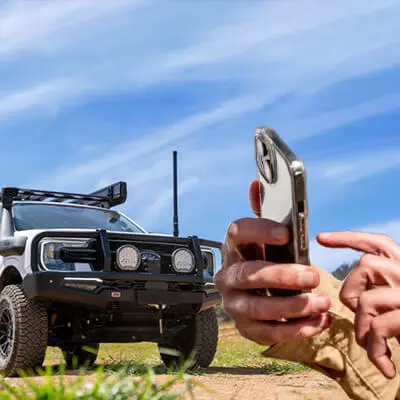
What Is a Mobile Signal Repeater?
A mobile signal repeater (also called a signal booster) improves weak mobile phone reception by:
- Capturing an existing external mobile signal
- Amplifying that signal
- Rebroadcasting it inside the vehicle
Repeaters do not create signal where none exists. Instead, they make a weak, unstable signal usable for:
- Calls
- SMS
- Mobile data
- Navigation and safety apps
In Australia, not all repeaters are legal — which is why CEL-FI is different.
Is CEL-FI Legal in Australia? (Short Answer: Yes)
CEL-FI is the only mobile repeater technology approved for legal use in Australia.
CEL-FI systems are:
- Approved by the ACMA
- Carrier-authorised (Telstra, Optus, Vodafone)
- Automatically network-managed
This makes CEL-FI fully legal for use in vehicles, caravans, homes, and commercial fleets.
Why Most Mobile Signal Boosters Are Illegal in Australia
Many low-cost signal boosters sold online:
- Transmit uncontrolled signal levels
- Interfere with mobile towers
- Cause network congestion
- Can disrupt emergency services
Because of this, Australia strictly regulates mobile repeaters.
Illegal boosters can:
- Degrade network performance
- Attract fines
- Be confiscated
CEL-FI avoids these issues by operating within carrier-controlled limits.
How CEL-FI Works (Simple Explanation)
CEL-FI systems use intelligent signal processing, not brute-force amplification.
Step-by-Step
- External antenna captures the strongest available mobile signal
- CEL-FI unit analyses signal quality and strength
- Signal is amplified only within permitted limits
- Internal antenna rebroadcasts signal inside the vehicle
If the signal quality drops or becomes unstable, CEL-FI automatically adjusts — or stops boosting — to protect the network.
This is why CEL-FI remains compliant and legal.
When Does CEL-FI Actually Help in Australia?
CEL-FI is most effective in borderline coverage areas, where:
- Signal exists but is too weak to use
- Calls drop out
- Data is unreliable
Common Australian Scenarios
- Regional highways
- Remote towns
- Farming and mining areas
- Caravan routes
- Edge-of-coverage zones
CEL-FI does not work in total black spots where no signal exists at all.
CEL-FI vs External Antennas — What’s the Difference?
External Antennas
- Improve signal capture
- Work well when signal is moderate
- Limited amplification
CEL-FI Repeaters
- Actively boost weak signals
- Improve call stability
- Increase usable data speeds
For many touring setups, the best results come from combining both.
👉 Internal link suggestion:
Explore smart antennas and repeaters in the 4×4 range
Why CEL-FI Is Popular for 4×4 Touring
CEL-FI systems are commonly used by:
- Touring families
- Caravanners
- Regional contractors
- Mining and civil fleets
- Emergency and support vehicles
Key Benefits
- Legal and carrier-approved
- Improves call clarity
- Reduces dropouts
- Boosts usable mobile data
- Works while driving
For long-distance Australian travel, these benefits can significantly improve safety and convenience.
Typical CEL-FI Vehicle Setup
A standard 4×4 installation includes:
- Roof-mounted or bullbar-mounted external antenna
- CEL-FI repeater unit inside the cabin
- Internal antenna for signal distribution
Correct antenna placement is critical to performance.
👉 Related guide:
UHF Antenna Gain Explained: 3dB vs 6dB vs 9dB (Australia)
CEL-FI and 4G vs 5G Networks
CEL-FI systems are designed to work with:
- 4G LTE networks
- Select 5G frequencies (carrier-dependent)
In most regional and remote areas, 4G remains the dominant usable network, which is where CEL-FI performs best.
5G availability is still limited outside metro zones.
Do You Still Need UHF If You Have CEL-FI?
Yes — for most Australian travellers.
CEL-FI Is Best For:
- Phone calls
- Data access
- Emergency services
- Navigation
UHF Is Essential For:
- Convoy communication
- Off-road coordination
- Recovery situations
- Areas with no mobile signal
Most experienced tourers run both systems together.
👉 Internal reference:
4×4 Touring Communication Checklist (Australia): UHF, Mobile Signal & Safety
Installation Considerations for CEL-FI
Mounting Tips
- External antenna mounted high and clear
- Internal antenna separated from external antenna
- Quality coaxial cabling
Professional Installation Recommended
CEL-FI systems require correct antenna separation and tuning.
Incorrect installation can:
- Reduce performance
- Cause oscillation shutdowns
- Waste the investment
👉 Internal link:
Professional installation services
Common Myths About CEL-FI
❌ CEL-FI works everywhere
✔ It boosts weak signal not zero signal
❌ Any booster is fine
✔ Only CEL-FI is legal in Australia
❌ Antennas alone do the same job
✔ Repeaters provide active amplification
Understanding these differences avoids disappointment.
Who Should Consider CEL-FI?
CEL-FI makes sense if:
- You travel regionally or remotely
- You rely on mobile calls or data
- You tow caravans
- You work in off-grid locations
- Safety and reliability matter
For city-only drivers, CEL-FI is usually unnecessary.
Final Recommendation
CEL-FI is legal, carrier-approved, and purpose-built for Australian conditions.
When paired with a quality external antenna, it:
- Improves communication reliability
- Enhances safety
- Reduces frustration in weak coverage areas
For serious 4×4 touring, CEL-FI is one of the most effective mobile connectivity upgrades available.
Next Step
To see how CEL-FI fits into a complete off-grid setup, read the full guide:
👉 4×4 Connectivity in Remote Australia: The Ultimate Guide to UHF, 4G/5G & Smart Antennas (2025 Edition)
👉 Browse the full 4×4 connectivity range