


How Vehicle Message Displays Improve Traffic Control and Road Safety in Australia
Why Clear Communication Matters on Australian Roads
Australia’s road network is vast, diverse, and constantly changing. Every day, road users encounter construction zones, maintenance works, utility crews, emergency response vehicles, traffic management operations, and roadside service teams. In these environments, clear communication becomes critical for both worker safety and driver awareness.
Traditional warning signs and flashing lights remain important, but modern traffic management increasingly relies on traffic control message boards and vehicle message displays to communicate real-time information directly to road users.
Whether it’s a roadworks crew operating on a regional highway, a council maintenance team managing roadside works, or an emergency response vehicle attending an incident, the ability to display clear, visible, and immediate instructions can significantly improve safety outcomes.
As Australian road authorities, councils, utility providers, and traffic management companies continue focusing on reducing risks for workers and motorists, the use of road safety message boards and traffic management message boards has become increasingly common.
This guide explains how vehicle message displays improve traffic control, enhance safety, and help organisations communicate more effectively in dynamic road environments.
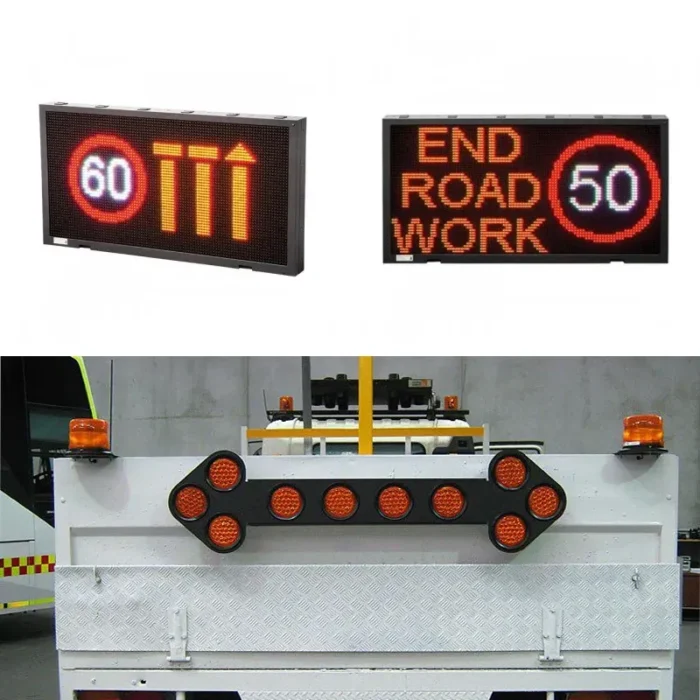
The Problem: Drivers Have Less Time to React Than Ever
Modern roads are busier than ever.
Australian drivers face:
- Increasing traffic volumes
- Higher-speed regional roads
- Roadworks and temporary traffic conditions
- Utility maintenance activities
- Emergency incidents
- Distracted driving behaviour
- Reduced visibility in poor weather
When motorists do not receive sufficient warning about changing road conditions, reaction times decrease significantly.
This creates risks such as:
- Sudden braking
- Unsafe lane changes
- Rear-end collisions
- Worker exposure
- Vehicle-to-vehicle accidents
- Reduced traffic flow efficiency
For traffic management operators, the challenge is simple:
How do you quickly communicate important safety information to approaching motorists?
Why Traditional Warning Methods Are Not Always Enough
For decades, traffic control relied heavily on:
- Static road signs
- Safety cones
- Arrow boards
- Flashing beacons
- Temporary barriers
While these remain important, they have limitations.
Static signs cannot adapt to changing situations.
A road crew may need to communicate:
- Slow Down
- Prepare To Stop
- Roadworks Ahead
- Traffic Controller Ahead
- Utility Works
- Lane Closed
- Emergency Response
Traditional signs cannot easily change to suit evolving conditions.
This is where electronic safety message displays provide a major advantage.
The Solution: Vehicle Message Displays
A vehicle message display Australia solution allows operators to communicate specific, highly visible messages directly to road users.
Unlike static signage, a programmable LED message board can display multiple messages depending on the situation.
This flexibility helps traffic management teams improve communication while supporting safer decision-making by drivers.
Common applications include:
- Traffic management operations
- Council maintenance activities
- Utility works
- Road construction projects
- Emergency response
- Fleet safety operations
Modern traffic control message boards allow operators to adapt messaging instantly without replacing physical signage.
How Vehicle Message Displays Improve Road Safety
One of the biggest advantages of a road safety message board is its ability to improve driver awareness before motorists reach a hazard.
When drivers receive clear instructions earlier, they can:
- Reduce speed safely
- Change lanes gradually
- Increase following distance
- Prepare for traffic changes
- Respond more predictably
This reduces sudden manoeuvres and lowers the likelihood of accidents.
Answering a Common Question:
How Vehicle Message Displays Improve Road Safety
Vehicle message displays improve road safety by:
- Providing advance warning
- Increasing visibility
- Delivering clear instructions
- Supporting traffic management plans
- Reducing driver confusion
- Improving worker protection
This is why traffic warning displays are increasingly used across Australian road networks.
Traffic Management Vehicles and LED Message Boards
Traffic management companies operate in highly dynamic environments where conditions can change quickly.
A lane closure that begins as routine maintenance can become a complex traffic management situation within minutes.
Using a traffic management message board allows operators to:
- Display changing instructions
- Adapt to incidents
- Improve driver compliance
- Reinforce temporary traffic controls
Because messages can be updated instantly, traffic management vehicles remain flexible and responsive.
Why Traffic Management Vehicles Use LED Message Boards
Traffic management vehicles use LED message boards because they:
- Increase visibility
- Improve communication
- Support worker safety
- Adapt to changing conditions
- Reduce confusion for motorists
For many contractors, these systems have become standard fleet equipment.
Roadworks and Construction Vehicle Applications
Road construction remains one of the most common applications for construction vehicle message displays.
Roadworks environments often involve:
- Reduced speed zones
- Lane closures
- Heavy equipment movement
- Temporary traffic arrangements
- Worker exposure
A highly visible roadworks message display helps communicate these risks well before motorists reach the work zone.
Typical messages include:
- Roadworks Ahead
- Slow Down
- Prepare To Stop
- Traffic Controller Ahead
- Lane Closed
This improves compliance and supports safer work environments.
Councils and Municipal Operations
Local governments manage thousands of kilometres of roads across Australia.
Council fleets regularly perform:
- Road maintenance
- Tree management
- Drainage works
- Infrastructure inspections
- Community projects
A council vehicle message board provides an effective way to notify motorists about temporary disruptions while maintaining safe traffic flow.
Many councils now use:
- Municipal LED message displays
- Vehicle mounted message boards
- Traffic warning displays
to support everyday operations.
These systems improve visibility while helping councils meet their public safety obligations.
Utility Vehicles and Infrastructure Projects
Utility providers operate in environments where workers frequently interact with live traffic.
Typical sectors include:
- Water authorities
- Electricity providers
- Telecommunications contractors
- Gas utilities
For these organisations, an electronic safety message display helps create awareness around:
- Roadside works
- Utility maintenance
- Temporary lane restrictions
- Emergency repairs
The ability to update messaging quickly improves both safety and operational efficiency.
Emergency Response Applications
Emergency services often need to communicate rapidly changing information.
Vehicle message displays support:
- Incident management
- Traffic diversion
- Road closures
- Emergency response operations
A LED warning message board can provide immediate visual instructions while supporting existing warning systems.
This makes them particularly valuable during:
- Major incidents
- Flood events
- Bushfire response
- Hazard management operations
Reducing Driver Confusion Through Clear Messaging
One of the biggest contributors to traffic incidents is uncertainty.
Drivers who do not understand what is happening ahead are more likely to:
- Brake suddenly
- Change lanes unpredictably
- Ignore traffic management instructions
A programmable LED message board helps eliminate confusion by providing direct and visible communication.
Examples include:
- Slow Down
- Merge Left
- Road Closed Ahead
- Utility Works
- Traffic Control Ahead
Simple messaging often produces better compliance than multiple static signs.
Traffic Message Displays vs Traditional Warning Systems
Many organisations ask whether a traffic message display board replaces traditional warning systems.
The answer is no.
Instead, message displays work alongside:
- Arrow boards
- Warning lights
- Cones
- Temporary signage
- Traffic controllers
Together, these systems create a layered approach to safety.
Vehicle message displays simply provide an additional communication tool that improves driver awareness.
Choosing the Right Vehicle Message Display
The most effective approach is simple:
Start with how the vehicle is used, then choose a setup that matches those conditions.
When selecting a vehicle mounted message board, consider:
Vehicle Type
- Utility vehicles
- Traffic management trucks
- Council fleets
- Emergency response vehicles
Operating Environment
- Urban roads
- Regional highways
- Construction zones
- Utility worksites
Visibility Requirements
- Daytime operation
- Night operation
- High-speed environments
Message Flexibility
- Static messaging
- Multiple programmable messages
- Operational requirements
Matching the display to real-world usage ensures better outcomes.
Final Thoughts
Traffic management today requires more than cones and warning lights.
Clear communication plays a critical role in protecting workers, improving driver awareness, and supporting safer road environments.
Whether used as a traffic control message board, road safety message board, construction vehicle message display, or electronic safety message display, vehicle message displays help organisations communicate quickly and effectively.
By delivering clear instructions when and where they matter most, these systems contribute to safer roads, better traffic flow, and improved operational outcomes across Australia.
For councils, contractors, utilities, emergency services, and traffic management providers, vehicle message displays have become one of the most practical and effective safety tools available.