


Emergency vehicles, roadworks crews, traffic management teams, tow operators, utility workers and road maintenance fleets operate in some of the highest-risk environments on Australian and New Zealand roads.
Traditional emergency vehicle warning systems and roadside safety equipment, including warning lights, sirens, arrow boards, signs, beacons and traffic-management controls, remain fundamental.
But connected vehicle technology can add another layer of protection:
- warning approaching motorists digitally before they reach an emergency vehicle, roadside worker, active work zone or other roadway hazard.
HAAS Alert Safety Cloud ® ️ is a real-time V2X digital alerting and connected vehicle safety platform that enables equipped emergency vehicles, roadside fleets and roadway assets to send digital hazard information to motorists through supported navigation applications and compatible in-vehicle systems.
HAAS Alert states that Safety Cloud digital alerts can provide approaching motorists with up to 30 seconds of advance warning, giving drivers more time to recognize a hazard, slow down, move over where appropriate, and prepare for changing road conditions.
For fleet managers, road authorities, health and safety leaders and senior emergency-services decision-makers, the important distinction is simple:
- Warning lights provide visibility to the vehicle.
- Digital alerts can provide awareness before the vehicle.
Together, physical warning systems and connected digital alerting can create a broader approach to roadside worker safety, emergency vehicle awareness and fleet risk management.
HAAS Alert Australia and New Zealand: Australian Warning Systems Is the Authorized Distributor
HAAS Alert formally announced the distribution partnership on 20 July 2026 as part of the expansion of Safety Cloud across the Asia-Pacific region. The official announcement identifies Australian Warning Systems as HAAS Alert’s local partner for market development, customer engagement, deployment coordination, installation pathways and frontline customer support, with HAAS Alert providing platform, product and technical support.
This makes Australian Warning Systems the local point of contact for organizations evaluating HAAS Alert in Australia or New Zealand, including:
- Fire and rescue services
- Ambulance and emergency medical fleets
- Police and law-enforcement fleets
- Road authorities
- State and local government fleets
- Councils
- Traffic management companies
- Road maintenance contractors
- Construction and civil fleets
- Utilities
- Infrastructure providers
- Towing and recovery operators
- Roadside assistance fleets
- Transport fleets
- Other organizations with vehicles or personnel operating on or beside live roads
HAAS Alert’s ANZ partnership announcement specifically identifies emergency services, road authorities, traffic management, utilities, infrastructure, construction, towing, transport and other fleet operations as applications for Safety Cloud across Australia and New Zealand.
For Australian and New Zealand customers, this local partnership means Safety Cloud can be assessed not simply as an overseas technology product, but within the context of local vehicles, warning systems, fleet operations, installation requirements and road-safety applications.
What Is HAAS Alert Safety Cloud?
HAAS Alert Safety Cloud is a connected vehicle and V2X digital alerting platform designed to communicate real-time roadway hazard information between equipped vehicles or assets and approaching road users.
HAAS Alert’s Knowledge Base describes Safety Cloud as enabling first responders and roadway workers, including police, firefighters, EMS crews, tow trucks, and other roadside operators to send real-time alerts to nearby motorists through navigation applications and vehicle systems.
This creates a digital extension of traditional vehicle warning technology.
Instead of relying only on what a driver can physically see or hear, Safety Cloud can communicate the presence of an equipped emergency vehicle, roadside operation, or roadway hazard through supported connected systems.
For organizations researching V2X technology in Australia, connected vehicle safety in New Zealand, intelligent transport systems or digital road infrastructure, Safety Cloud demonstrates how vehicle location, warning-system status and connected platforms can work together to improve driver awareness.
How Does HAAS Alert Safety Cloud Digital Alerting Work?
A typical Safety Cloud digital-alerting workflow can be understood in six steps:
- An equipped emergency vehicle, fleet vehicle or roadway asset is operating on or beside the road.
- The relevant warning or emergency system is activated.
- The equipped vehicle communicates location and warning-system status to Safety Cloud.
- Safety Cloud processes and distributes the roadway hazard information.
- Supported navigation applications or compatible vehicle systems receive the information.
- Approaching motorists can receive a digital warning before reaching the immediate hazard area.
HAAS Alert describes its digital alerting transponder as a cellular and GPS-enabled device that communicates warning-light status from a connected vehicle to Safety Cloud so that digital alerts can be distributed to civilian drivers.
This process is designed to complement the fleet’s existing warning equipment rather than replace it.
How Do Drivers Receive Emergency Vehicle and Roadside Alerts?
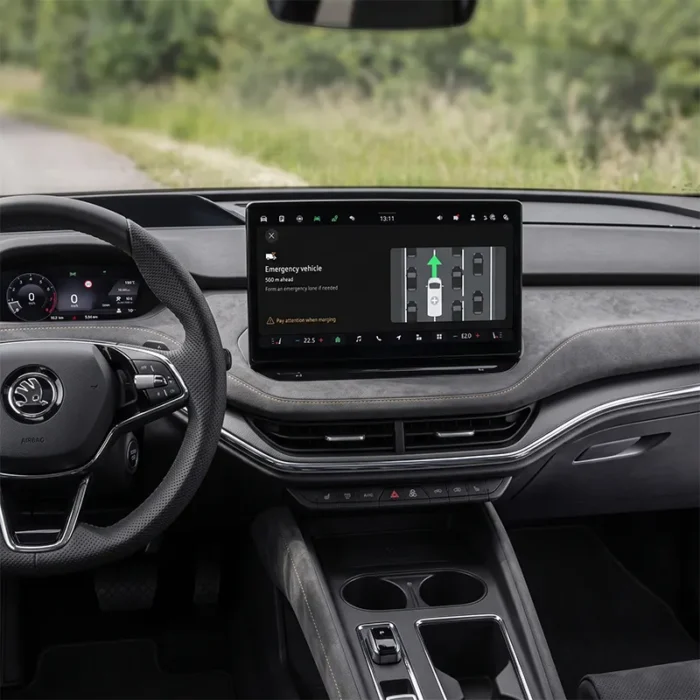
Drivers do not need to install a dedicated HAAS Alert consumer application to receive Safety Cloud digital alerts.
Safety Cloud distributes alerts through supported navigation applications and compatible in-vehicle infotainment systems.
HAAS Alert identifies Waze among its navigation partners and also lists automotive and connected-platform relationships that include Stellantis brands, Volkswagen and Škoda, with its partner ecosystem continuing to develop.
This means a motorist can potentially receive an emergency vehicle alert, roadside worker alert or work-zone warning through technology already present in the driving environment.
The exact alert-delivery platforms, vehicle integrations and functionality available for a specific Australian or New Zealand deployment should be confirmed as part of fleet assessment and implementation.
Moving Digital Alerts
Safety Cloud supports moving digital alerts for appropriately equipped vehicles.
For emergency services, this means a responding fire appliance, ambulance or police vehicle can use connected digital alerting while travelling with its emergency warning system activated.
Navigation applications such as Waze can receive both moving and stationary Safety Cloud alerts.
The result is another warning channel alongside emergency lighting and sirens.
Stationary Digital Alerts
Safety Cloud also supports stationary alerting around active roadside incidents, worksites and other operations.
This is particularly relevant for:
- Emergency incident scenes
- Roadworks
- Traffic management
- Tow truck and recovery operations
- Roadside assistance
- Utility maintenance
- Council road maintenance
- Infrastructure work
- Construction and civil works
- Other vehicles or assets operating beside live traffic
For road workers and responders, the objective is to increase the opportunity for approaching motorists to become aware of the hazard before entering the immediate physical warning area.
HA-7 Transponder Australia: Connecting Existing Vehicles to Safety Cloud
One of the most important questions for fleet managers is whether introducing connected vehicle safety technology requires replacing existing vehicles or warning systems.
In many cases, it does not.
The HA-7 Digital Alerting Transponder provides a pathway for connecting eligible existing vehicles and equipment to HAAS Alert Safety Cloud.
HAAS Alert states that the HA-7 can be installed on any fleet, vehicle or equipment and connects directly and synchronizes with flashing warning lights.
This is particularly relevant to Australian and New Zealand organizations operating mixed-age fleets that may include:
- Fire appliances
- Ambulances
- Police vehicles
- Emergency response vehicles
- Road maintenance trucks
- Traffic management vehicles
- Tow trucks
- Roadside assistance vehicles
- Utility vehicles
- Council fleets
- Dual-cab utilities
- Specialist vehicles
- Construction vehicles
- Plant and equipment
Instead of restricting V2X digital alerting to newly manufactured vehicles, the HA-7 can provide a connection between existing emergency vehicle warning systems and the Safety Cloud platform.
How Is the HA-7 Connected?
HAAS Alert’s installation documentation states that its digital alerting transponder requires:
- Constant 12-volt power
- Vehicle ground
- A 12-volt input indicating when digital alerts should be sent
- Appropriate fused electrical protection
The transponder contains cellular and GPS capability and communicates warning-light status to Safety Cloud. HAAS Alert also provides installation guidance regarding mounting, electrical connections, and optional external antenna use.
Operationally, this helps create a simple workflow.
The crew continues to operate its normal warning system. When the relevant warning lights or emergency-light controls are activated, Safety Cloud can receive the appropriate vehicle status without requiring operators to remember a separate motorist-alerting procedure.
That is particularly important in emergency response and roadside work environments where technology should support established workflows rather than add unnecessary operational complexity.
Is the HA-7 RCM Certified for Australia and New Zealand?
Yes.
HAAS Alert confirms that its digital alerting transponders are certified under the Regulatory Compliance Mark (RCM) for Australia and New Zealand.
HAAS states that the RCM certification indicates compliance with relevant Australian and New Zealand electrical safety and electromagnetic compatibility requirements.
For fleet managers, procurement teams, emergency-services engineering personnel and technical decision-makers, RCM status is an important consideration when evaluating connected hardware for Australian or New Zealand fleet deployment.
HA-Direct: Safety Cloud Integration Through Existing Fleet Telematics
The HA-7 is not the only method of connecting fleets to Safety Cloud.
HAAS Alert also provides HA-Direct, which enables Safety Cloud integration through supported existing telematics and fleet GPS platforms.
HAAS identifies integrations with platforms including Ericsson, Samsara and other fleet-management solutions, allowing some fleets to activate digital alerting without installing separate HA-7 hardware in each vehicle.
For a fleet manager planning a large deployment, the appropriate connection method may therefore depend on:
- Existing vehicle age
- Existing telematics
- Current GPS/fleet-management technology
- Emergency or warning-light configuration
- Fleet size
- Vehicle replacement cycles
- Operational requirements
- Available integrations
- Local service configuration
The HA-7 can be especially valuable for legacy or mixed fleets, while HA-Direct may provide another deployment pathway where compatible fleet technology is already installed.
Blue Light Digital Alerting for Emergency Services
HAAS Alert uses the term Blue Light Digital Alerting for its Safety Cloud application focused on emergency services.
For emergency-services leaders, digital alerting extends the traditional emergency vehicle warning system into supported navigation and connected vehicle environments.
Potential applications include:
- Fire and rescue
- Ambulance and EMS
- Police
- Public-safety fleets
- Other eligible emergency response vehicles
HAAS Alert’s current European Safety Cloud material describes its emergency-services platform as including moving alerts, on-scene alerting, fleet visibility, incident management and reporting capabilities.
Emergency Vehicle Alerts During Response
An emergency vehicle travelling under warning conditions creates a rapidly changing hazard environment.
Lights and sirens remain essential.
Digital alerting provides an additional opportunity to make motorists aware of an approaching emergency vehicle through supported connected technology.
For organizations researching terms such as emergency vehicle alerts Australia, fire truck warning systems, ambulance warning technology, police fleet safety technology or connected emergency vehicle systems, this is the core role of Safety Cloud’s moving digital alerting capability.
Digital Alerting at Emergency Scenes
Once an emergency vehicle reaches an incident, the risk does not disappear.
Responders may be working around:
- Moving traffic
- Lane closures
- Vehicle collisions
- Roadside incidents
- Night-time operations
- Restricted visibility
- Multiple emergency vehicles
- Complex traffic conditions
Safety Cloud can add an advanced digital-warning layer while traditional warning lights, traffic control and scene-management procedures continue to provide physical protection around the incident.
The model is therefore:
- Digital awareness before the encounter → emergency lights and sirens during the approach → physical warning and traffic management at the incident scene.
Amber Light Digital Alerting for Roadworks and Work-Zone Safety
HAAS Alert also uses the term Amber Light Digital Alerting for roadworks and work-zone applications.
Its current Safety Cloud material specifically describes protecting roadwork crews and work zones using real-time digital alerts, fleet visibility and incident coordination, including alerts for moving operations.
This is particularly relevant to organizations focused on:
- Road worker safety
- Roadworks safety
- Work zone safety
- Traffic management
- Road maintenance
- Mobile works
- Temporary work zones
- Infrastructure maintenance
- Road authority operations
Australian road-safety guidance continues to emphasize stronger protection for road workers and the use of innovative strategies and technology to reduce risk in work zones, while New Zealand research has similarly highlighted technology, clearer driver information and improved worksite safety as important areas for safer roadworks.
Digital alerting does not remove the need for approved traffic-management controls.
Instead, it provides another communication layer.
Amber warning lights and work-zone equipment provide physical warning.
Digital road hazard alerts can provide earlier connected awareness.
Roadside Worker Safety for Towing, Utilities, Councils and Other Fleets
Safety Cloud’s relevance extends beyond traditional emergency services and formal roadworks.
HAAS Alert identifies roadway workers and essential fleets including towing, utility and other roadside operations as Safety Cloud applications. Its Australia/New Zealand partnership additionally identifies traffic management, infrastructure, construction, transport and fleet operations.
Towing and Roadside Assistance
Tow truck operators and roadside assistance crews frequently work immediately beside moving traffic.
For these fleets, tow truck safety technology and connected vehicle alerts can complement highly visible warning lights by giving supported motorists an earlier digital indication of roadside activity ahead.
Utility Fleets
Electricity, telecommunications, water and other utility crews may work on road shoulders, verges, intersections and other locations exposed to traffic.
Connected digital alerting can form part of a broader utility fleet safety and roadside worker protection strategy.
Councils and Road Authorities
Councils, municipalities and road authorities manage diverse fleets covering:
- Road maintenance
- Asset inspection
- Infrastructure
- Public works
- Incident response
- Traffic management
- Mobile maintenance operations
For these organizations, Safety Cloud combines digital hazard communication with fleet visibility and reporting capabilities.
Construction and Civil Fleets
Civil construction and infrastructure vehicles may frequently transition between controlled worksites and live-road environments.
Where crews and equipment interact with public traffic, connected alerts can provide another layer of awareness alongside existing work-zone controls.
Transport and Other Fleet Operations
HAAS Alert’s official Australia/New Zealand partnership announcement also identifies transport fleets among the sectors targeted by its regional expansion.
The practical question for a fleet manager is therefore not simply:
“Are we an emergency service?”
It is:
“Do our people, vehicles or assets regularly operate on or beside live roads where earlier motorist awareness could improve safety?”
If the answer is yes, connected vehicle digital alerting may be worth evaluating.
Warning Lights vs Digital Alerts: Why Fleets Need Both
Traditional warning systems and connected alerts solve different parts of the same roadside safety challenge.
Emergency and Amber Warning Lights
Physical vehicle warning systems provide immediate local visual information.
Depending on the vehicle and operation, these can include:
- LED lightbars
- Warning beacons
- Directional lighting
- Arrow boards
- Sirens
- Vehicle-mounted signs
- Variable message equipment
- Traffic-management devices
They remain critical around the physical vehicle, crew and worksite.
Digital Vehicle Alerts
Digital alerts communicate hazard information through supported connected platforms.
Their principal advantage is reach.
A driver may receive information about the emergency vehicle, roadside operation or work zone before physically seeing the warning lights.
For a fleet manager assessing emergency vehicle warning technology, the choice should therefore not be framed as:
warning lights OR digital alerting.
A better model is:
warning lights + digital alerting + appropriate operational controls.
Safety Cloud does not replace regulatory, vehicle, workplace or traffic-management requirements.
Safety Cloud Dashboard: Connected Fleet Safety and Situational Awareness
Safety Cloud is more than an emergency vehicle alerting system.
HAAS Alert also provides a situational-awareness Dashboard that can show authorized users the location and alert status of equipped vehicles and assets.
HAAS describes the Dashboard as a customisable control center for connected fleets and also provides monthly personalised reporting to help users understand activity and operational trends.
For decision-makers responsible for fleet safety, emergency response, road maintenance or roadside operations, this means Safety Cloud can support both:
external communication to approaching motorists
and
internal operational visibility across the connected fleet.
New Safety Cloud Mobile App
On 5 August 2026, HAAS Alert announced a significant Safety Cloud platform update, including the introduction of a dedicated Safety Cloud mobile app for Apple iOS and Android.
The app is designed for authorized Safety Cloud fleet and agency users—not as a consumer app motorists must download to receive alerts.
HAAS states that command staff and field personnel can use the mobile app to view live vehicle and equipment activity, monitor incidents, and access fleet information from mobile devices. Users can view vehicle status, speed, location, and other live information.
This is particularly relevant to:
- Emergency-services command personnel
- Fleet managers
- Duty officers
- Operational supervisors
- Road authority managers
- Field personnel
- Multi-site fleet operations
For senior decision-makers, mobile access extends connected fleet visibility beyond the desktop Dashboard.
Mutual Aid Sharing for Emergency Services
The August 2026 Safety Cloud update also expanded Mutual Aid Sharing to Safety Cloud public-safety agencies.
Participating agencies can request connections with trusted Safety Cloud agencies and, once approved, share live apparatus location and status information.
HAAS identifies use cases including:
- Mutual-aid responses
- Regional task forces
- Planned events
- Drills and exercises
- Large-scale emergencies
- Disaster response
The objective is to provide emergency-services leaders with greater real-time visibility across participating organizations when response activity extends beyond one agency or jurisdiction.
For fire, ambulance, police, and emergency-management decision-makers, this moves Safety Cloud beyond motorist warning into broader emergency-services situational awareness and inter-agency coordination.
Safety Cloud Asset Activity Reports
HAAS Alert’s August 2026 update also introduced Asset Activity Reports.
These can be generated on demand for selected vehicles or assets over a chosen date range.
HAAS identifies metrics including:
- Drivers alerted
- Total incidents
- Average time on scene
For public-safety fleets, additional metrics can include:
- Total runs
- Total responding time
- Average time to scene
- Responder-to-Responder alerts sent
- Responder-to-Responder alerts received
Reports can be exported as PDF documents for operational reviews, grant applications, budget requests and other management purposes.
For fleet executives and senior emergency-services leaders, this creates a stronger connection between fleet safety technology and measurable operational information.
Dashboard Clustering for Large Fleets
Large fleets create a different fleet-management challenge: too many vehicles displayed in one area can make a live map difficult to interpret.
HAAS Alert’s 2026 Dashboard Clustering feature groups overlapping assets into clusters that can then be expanded for greater detail.
Clustering works across both the Dashboard and the mobile app and is designed to scale from smaller operations through to fleets containing large numbers of connected assets.
This can be particularly relevant to:
- Large emergency-services fleets
- Councils
- Road authorities
- Utilities
- State-wide operations
- Major infrastructure fleets
- Multi-depot organizations’
Safety Cloud Knowledge Base
The 2026 Safety Cloud update also added a new in-product Knowledge Base accessible through the Dashboard.
HAAS states that the Knowledge Base provides step-by-step guidance covering Dashboard functionality and ongoing platform features.
For fleet deployments, easier access to product information can support administrators and authorized users as Safety Cloud functionality expands.
Responder-to-Responder Digital Alerting for Emergency Vehicles
Safety Cloud also offers Responder-to-Responder (R2R™️) digital alerting for eligible public-safety fleets.
R2R addresses a different risk from standard motorist digital alerting.
Instead of:
emergency vehicle → civilian motorist
R2R supports:
emergency vehicle → emergency vehicle
HAAS Alert describes R2R as an electronic notification system that alerts first responders when another Safety Cloud-equipped emergency vehicle is actively responding and approaching the same intersection or turn.
R2R is an add-on service and requires an existing Safety Cloud digital-alerting subscription.
How Does R2R Work?
HAAS Alert supplies LED indicators that can be mounted in the cab or on the vehicle pillars.
When appropriately equipped emergency vehicles approach the same intersection or potential conflict point while responding, the LED indicator flashes.
HAAS states that this can provide approximately 10–15 seconds of warning to help responders recognize the potential conflict and act accordingly.
The system can also recognize vehicles travelling in tandem to avoid generating unnecessary alerts in that scenario.
For organizations researching emergency vehicle collision avoidance, fire appliance safety, ambulance fleet safety, police fleet safety or connected emergency response technology, R2R adds a separate layer of responder awareness.
Why Road Worker Safety Is Becoming a Connected Vehicle Issue
Road worker protection has traditionally focused heavily on the physical work zone.
That remains essential.
But connected vehicles are changing how road users receive information.
Austroads’ current work on emerging mobility technology across Australia and New Zealand identifies connected and automated vehicles, digital infrastructure and reliable vehicle communications as important elements of future-ready road networks.
This broader shift matters for road workers.
A work zone can increasingly be communicated not only through:
- Signs
- Cones
- Barriers
- Arrow boards
- Warning vehicles
- Traffic controllers
- Variable message signs
but also through digital road information delivered into supported connected vehicles and navigation systems.
Safety Cloud operates within this broader transition toward connected road safety by turning appropriately equipped vehicles and assets into sources of real-time digital hazard information.
Benefits for Fleet Managers and Senior Decision-Makers
For a fleet manager, safety manager, road authority executive or emergency-services leader, Safety Cloud should be evaluated at an organizational level rather than simply as another piece of vehicle hardware.
Potential areas to assess include:
Earlier Driver Awareness
Digital alerts extend hazard communication beyond the physical visibility range of a vehicle’s warning lights.
Roadside Worker Protection
Earlier awareness can provide approaching motorists with more opportunity to recognize an active roadside operation before reaching workers or equipment.
Emergency Response Safety
Moving alerts can add another connected warning channel during emergency response.
Existing Fleet Compatibility
The HA-7 provides an option for eligible existing vehicles, while supported HA-Direct integrations provide another pathway for fleets already using compatible telematics.
Fleet Visibility
The Safety Cloud Dashboard and mobile app provide authorized personnel with information about connected fleet activity.
Operational Reporting
Monthly reports and Asset Activity Reports can provide data for operational review, management reporting and planning.
Public-Safety Coordination
Mutual Aid Sharing and R2R can add connected situational-awareness capabilities specifically relevant to emergency-services organizations’.
Scalable Fleet Deployment
Safety Cloud can be considered across individual vehicles, mixed fleets and larger multi-asset operations, subject to configuration and compatibility.
What Australian and New Zealand Fleets Should Confirm Before Deployment
Any connected vehicle safety system should be assessed against the fleet’s actual vehicles, operating conditions and safety objectives.
Before deploying HAAS Alert Safety Cloud in Australia or New Zealand, decision-makers should consider the following.
1. Define the Road-Safety Problem
Identify what the organization wants to improve.
Examples include:
- Roadside worker safety
- Emergency vehicle awareness
- Work-zone warning
- Tow truck protection
- Utility crew safety
- Emergency response
- Intersection risk
- Fleet situational awareness
- Multi-agency coordination
2. Identify Eligible Vehicles and Assets
Determine which vehicles, apparatus or roadside assets are candidates for digital alerting.
3. Select the Connection Method
Assess whether each vehicle is best suited to:
- HA-7 Transponder
- HA-Direct integration
- Another supported integration pathway
4. Check Existing Warning-System Integration
Confirm how the vehicle’s emergency lights, amber warning lights, or other relevant activation circuit will communicate with Safety Cloud.
5. Confirm Alert-Delivery Compatibility
Confirm the supported navigation applications, connected-vehicle systems and current alert-delivery configuration relevant to the Australian or New Zealand deployment.
HAAS Alert continues to expand its navigation and automotive partnerships, so compatibility should be confirmed rather than assumed.
6. Assess Fleet Management Requirements
Determine who requires Dashboard or mobile-app access and what operational information is important to the organization.
7. Consider Reporting Requirements
For management teams, identify whether monthly reporting or Asset Activity Reports could support:
- Safety reviews
- Fleet performance discussions
- Executive reporting
- Budget requests
- Grant applications
- After-action reviews
- Operational planning
8. Assess Emergency-Services Features
Public-safety organizations should separately consider whether:
- Responder-to-Responder
- Mutual Aid Sharing
- Mobile operational visibility
- Fleet incident monitoring
are relevant to their operational model.
9. Confirm RCM and Installation Requirements
HAAS Alert’s digital alerting transponders carry RCM certification for Australia and New Zealand, but each installation must still be planned appropriately for the vehicle and application.
10. Use the Local Authorized Distributor
Australian Warning Systems is HAAS Alert’s appointed Authorized Distributor for Safety Cloud in Australia and New Zealand and supports local customer engagement, deployment coordination, installation pathways and frontline support.
Frequently Asked Questions About HAAS Alert Safety Cloud Australia and New Zealand
Is HAAS Alert available in Australia?
Yes. HAAS Alert formally announced its Australian and New Zealand partnership with Australian Warning Systems in July 2026. Australian Warning Systems is the appointed Authorised Distributor for Safety Cloud in the region.
Is HAAS Alert available in New Zealand?
Yes. The HAAS Alert and Australian Warning Systems distribution partnership covers both Australia and New Zealand, with Safety Cloud intended for emergency services, road authorities, traffic management, utilities, infrastructure, towing and other fleet applications.
Who is the authorized HAAS Alert distributor in Australia?
What is HAAS Alert Safety Cloud?
Safety Cloud is a V2X digital alerting and connected vehicle safety platform that enables equipped emergency vehicles, roadside fleets and roadway assets to send real-time hazard information to drivers through supported navigation applications and compatible in-vehicle systems.
What is V2X digital alerting?
V2X, or vehicle-to-everything, describes communication between vehicles and other elements of the road environment. Safety Cloud uses connected vehicle technology to distribute real-time digital hazard alerts from equipped emergency and roadway vehicles to supported driver platforms.
How much warning does HAAS Alert provide?
HAAS Alert states that Safety Cloud can provide motorists with up to 30 seconds of warning, giving drivers more time to slow down, move over where appropriate, and respond to the roadway situation.
Do motorists need a HAAS Alert app?
No dedicated HAAS Alert consumer app is required for motorists to receive digital alerts. Safety Cloud sends alerts through supported navigation applications and compatible in-vehicle systems.
Does HAAS Alert work with Waze?
Yes. HAAS Alert identifies Waze as one of the navigation applications capable of receiving Safety Cloud digital alerts.
Does HAAS Alert replace emergency warning lights?
No. Safety Cloud is an additional connected warning layer. Emergency lights, sirens, amber warning systems, traffic-management equipment and other required physical safety measures remain essential.
Can HAAS Alert work with existing warning lights?
Yes. HAAS Alert states that the HA-7 connects directly and synchronizes with flashing lights, enabling eligible existing warning-equipped vehicles to connect with Safety Cloud.
Can HAAS Alert be installed on older vehicles?
Yes, potentially. HAAS Alert states that Safety Cloud can be equipped regardless of the age, make or model of the alerting vehicle through available connection methods, including the HA-7.
What is the HA-7 Transponder?
The HA-7 is a cellular and GPS-enabled digital alerting transponder that can communicate a connected vehicle’s warning-light status to Safety Cloud so digital alerts can be distributed to supported driver platforms.
Is the HA-7 RCM certified?
HAAS Alert confirms that its digital alerting transponders carry RCM certification for Australia and New Zealand.
What is Blue Light Digital Alerting?
Blue Light Digital Alerting is HAAS Alert’s connected safety application for emergency services, supporting functions that can include moving alerts, on-scene digital alerting, fleet visibility and reporting.
What is Amber Light Digital Alerting?
HAAS Alert positions Amber Light Digital Alerting around roadworks and work-zone safety, combining connected digital alerts with fleet visibility and related Safety Cloud functionality.
Can HAAS Alert improve road worker safety?
Safety Cloud is designed to give approaching drivers earlier information about equipped roadway workers, vehicles and hazards through supported connected platforms. It complements rather than replaces established traffic-management and roadside safety controls.
Can Safety Cloud be used by tow trucks?
Yes. HAAS Alert identifies towing and recovery fleets as a Safety Cloud application, and towing is specifically included in its Australia and New Zealand partnership.
Can Safety Cloud be used by utility fleets?
Yes. HAAS Alert provides Safety Cloud applications for maintenance and utility fleets and specifically includes utilities in its Australia and New Zealand partnership.
Can councils and road authorities use Safety Cloud?
Yes. Road authorities and broader government and roadside fleet applications form part of the Safety Cloud ecosystem, and road authorities are specifically identified in HAAS Alert’s Australian and New Zealand rollout.
Does Safety Cloud provide fleet tracking and visibility?
Safety Cloud includes a situational-awareness Dashboard that can display the location and alert status of equipped vehicles and assets to authorized users.
Does Safety Cloud have a mobile app?
Yes. In August 2026, HAAS Alert released a Safety Cloud mobile app for authorized fleet and agency users on iOS and Android. This is separate from the navigation and vehicle systems through which motorists receive Safety Cloud alerts.
What are Safety Cloud Asset Activity Reports?
Asset Activity Reports are on-demand reports covering selected vehicles or assets over a selected date range. Available metrics can include drivers alerted, incidents, and time on scene, with additional response metrics available to public-safety fleets.
What is Safety Cloud Mutual Aid Sharing?
Mutual Aid Sharing allows participating Safety Cloud public-safety agencies to establish approved connections and share live apparatus location and status information for purposes such as mutual-aid responses, regional operations, and large-scale incidents.
What is Responder-to-Responder digital alerting?
Responder-to-Responder, or R2R™️, is an add-on Safety Cloud service for eligible public-safety fleets. It alerts responders when another participating Safety Cloud-equipped emergency vehicle is actively responding toward the same intersection or potential conflict point.
How much warning can R2R provide?
HAAS Alert states that R2R’s in-cab LED indicator can provide approximately 10–15 seconds of warning when participating emergency vehicles approach the same intersection or turn.
HAAS Alert Safety Cloud: Extending Roadside Warning Beyond the Vehicle
Roadside safety depends on layers.
Emergency lights, amber beacons, sirens, signs, arrow boards, barriers, traffic-management controls and safe operating procedures continue to provide the physical protection and communication required around vehicles and work zones.
HAAS Alert Safety Cloud adds a connected digital layer.
For emergency services, digital alerts can extend emergency vehicle warning systems into supported navigation applications and connected vehicles.
For road authorities and traffic management operators, work-zone digital alerting can help communicate roadworks and roadside activity before motorists reach the immediate work area.
For towing, utilities, councils, infrastructure and other fleets, connected vehicle alerts can complement existing roadside warning equipment.
For fleet managers, Safety Cloud now also provides capabilities including:
- Situational-awareness Dashboard
- Safety Cloud mobile app
- Monthly reporting
- Asset Activity Reports
- Dashboard Clustering
- Mutual Aid Sharing for public safety
- Responder-to-Responder alerting for eligible emergency fleets
- HA-7 and supported telematics deployment options
HAAS Alert’s August 2026 update confirms that the mobile app, expanded Mutual Aid Sharing, Asset Activity Reports, Dashboard Clustering and in-product Knowledge Base are now part of the Safety Cloud platform.
For Australian and New Zealand organizations, the opportunity is therefore broader than simply adding another device to a vehicle.
It is about connecting vehicle warning technology, digital driver awareness, and fleet visibility.
- Warning lights provide visibility in the vehicle.
- Digital alerts can provide awareness before the vehicle.
- Connected fleet technology can provide decision-makers with greater operational visibility.
Talk to the Authorized HAAS Alert Distributor for Australia and New Zealand
If your organization is evaluating HAAS Alert Safety Cloud, V2X digital alerting, emergency vehicle alerts, road worker safety technology, work-zone digital alerting or connected fleet safety, Australian Warning Systems can help assess the most appropriate deployment approach.
As the appointed Authorized Distributor for HAAS Alert Safety Cloud in Australia and New Zealand, Australian Warning Systems provides a local pathway for organizations considering:
- HAAS Alert Safety Cloud
- HA-7 Transponder deployment
- Existing warning-light integration
- Emergency vehicle digital alerting
- Roadworks and work-zone digital alerting
- Tow truck and roadside fleet safety
- Utility and infrastructure fleet safety
- Traffic management applications
- Fleet rollout planning
- Responder-to-Responder
- Safety Cloud fleet functionality
- Installation pathways
- Ongoing local frontline support
Whether you manage a small specialized fleet or a large emergency-service, road authority, council, utility, traffic-management or infrastructure operation, the first step is to determine where digital alerting can add meaningful value to your existing road-safety strategy.
- Contact Australian Warning Systems to discuss HAAS Alert Safety Cloud for your fleet in Australia or New Zealand, request a demonstration, or assess HA-7 and connected digital-alerting deployment options.
Deployment Note
Safety Cloud functionality, alert-delivery channels, connected-vehicle integrations, vehicle compatibility, and service configuration can vary by deployment. Australian and New Zealand organizations should confirm current requirements and availability for their specific fleet, vehicles and intended application before purchase or installation.