


An emergency vehicle siren is easy to recognise on the road, but the equipment behind that sound is more involved than a speaker mounted behind a grille.
A complete system can include a siren amplifier, one or more compatible speakers, operator controls, PA functions and connections to other warning equipment. The right configuration can also change according to the vehicle, electrical system, available mounting space and operational requirements.
That is why choosing emergency vehicle siren systems in Australia should start with the complete vehicle application rather than a single component.
A police vehicle working in metropolitan traffic, an ambulance moving through busy intersections and a fire appliance responding with a larger warning package do not necessarily need identical configurations. Even when two systems use a 100W speaker, their amplifier, controller, voltage and installation requirements may differ.
This guide explains how siren systems work, what the individual components do, how speakers and amplifiers need to work together, what 100W and 200W systems actually mean, and what emergency fleets should consider when planning or upgrading an audible warning system.
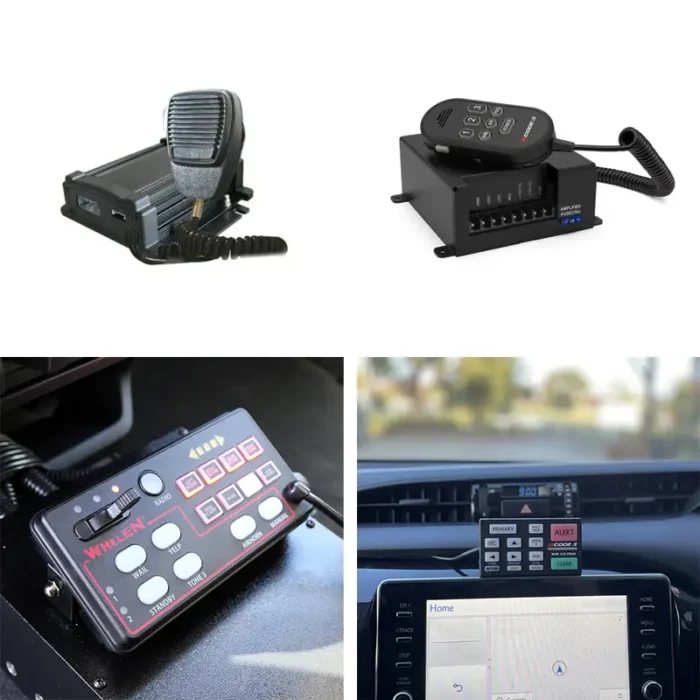
Emergency vehicle siren system components, including siren amplifiers, speakers and operator controls for authorised response vehicles.
How Does an Emergency Vehicle Siren System Work?
An emergency siren system takes an operator-selected warning function and converts it into the powerful audible signal produced by the vehicle’s siren speaker.
A simplified system can be understood as:
Operator control → Siren amplifier → Siren speaker → Audible warning
Depending on the equipment, the system may also include a microphone for public-address communication, multiple speaker outputs, warning-light controls or other integrated functions.
Each component has a different job.
The controller gives the vehicle operator access to the available functions. The amplifier generates and drives the required audio output. The speaker converts that electrical output into the warning sound heard outside the vehicle.
This distinction becomes important when choosing vehicle siren amplifiers and speakers in Australia because a speaker alone is not a complete siren system.
What Are the Main Components of an Emergency Vehicle Siren System?
Although configurations vary by manufacturer and vehicle, most systems are built around several core components.
| Component | Primary function | Key selection considerations |
| Siren amplifier | Generates and powers the warning signal | Output, channels, voltage and compatible speakers |
| Siren speaker | Converts amplifier output into audible warning | Power rating, impedance, physical design and compatibility |
| Controller | Allows the operator to select functions | Controls required and system compatibility |
| PA microphone | Provides voice communication | Whether PA functionality is required |
| Mounting hardware | Secures equipment to the vehicle | Vehicle position, space and manufacturer requirements |
| Electrical installation | Connects the system to the vehicle | Voltage, wiring, protection and system design |
Thinking about these components as one system helps prevent a common purchasing mistake: selecting a siren speaker first and trying to find an amplifier for it afterwards.
The better approach is to establish the required system configuration and then confirm that its components are designed to work together.
What Does a Siren Amplifier Actually Do?
A siren amplifier sits at the centre of the audible warning system.
It provides the electrical output needed to drive the siren speaker and, depending on the model, can also provide selectable warning tones, PA functionality and additional controls.
This makes vehicle siren amplifiers Australia an important specification decision rather than simply an accessory behind the speaker.
For example, a system may offer warning functions such as wail, yelp and air horn, while another amplifier may provide multiple independent speaker channels or additional control capabilities.
The required amplifier therefore depends on the complete system.
Before selecting one, check factors such as:
- rated output;
- number of output channels;
- speaker requirements;
- impedance requirements;
- vehicle voltage;
- available controls;
- PA functionality; and
- manufacturer compatibility.
A higher output rating does not automatically make one amplifier more appropriate than another.
Siren Speaker vs Siren Amplifier: What’s the Difference?
A siren speaker and a siren amplifier work together, but they do very different jobs within an emergency vehicle warning system. Understanding that difference is important when selecting new equipment or replacing an existing component.
The siren amplifier manages and supplies the electrical signal needed to produce the selected warning tones. Depending on the system, it may also support functions such as PA communication, different siren tones or additional controls. The siren speaker takes that signal and turns it into the audible warning heard outside the vehicle.
Because the two components operate as part of the same system, compatibility matters. A speaker should not be selected simply because its size fits the available mounting space or because its wattage looks suitable. Its power rating, impedance, amplifier requirements and intended configuration all need to be checked.
This is particularly important when comparing emergency vehicle siren speakers in Australia. Two speakers may look almost identical from the outside but have different electrical specifications, mounting requirements or compatible amplifier configurations. Checking these details before installation helps ensure the speaker and amplifier are properly matched for the vehicle.
How Should a Siren Speaker and Amplifier Be Matched?
This is one of the most important decisions when building or replacing an emergency warning system.
A 100W label on a speaker and a 100W label on an amplifier do not, by themselves, prove that the two components should be connected.
Compatibility can involve several specifications.
Power rating
The amplifier output and speaker rating need to suit the intended system configuration.
Impedance
Speaker impedance is an important electrical specification and needs to match the requirements of the amplifier.
Number of speakers
Some systems are designed around a single speaker. Others may provide multiple channels or support a different speaker arrangement.
Voltage
The vehicle’s electrical system also matters. Equipment may be designed for 12V, 24V or multiple voltage applications.
Manufacturer specifications
The manufacturer’s approved or specified system configuration should always take priority over generic assumptions.
This is why professional vehicle siren amplifier systems Australia should be considered as complete systems rather than a collection of independently selected parts.
100W vs 200W Siren Systems: What Does the Rating Mean?
The difference between a 100W and 200W siren system sounds straightforward, but wattage alone does not tell you which system is appropriate.
A 100W configuration may use one amplifier output and one compatible speaker.
A 200W system may use a different amplifier architecture, including configurations with two 100W channels and two speakers.
That doesn’t mean:
200W = automatically better.
The appropriate system depends on the vehicle, amplifier design, speaker configuration, manufacturer requirements and intended application.
When comparing systems, look beyond the headline wattage and check:
amplifier output + number of channels + speaker specification + impedance + voltage + complete system compatibility.
This is much more useful than choosing equipment simply because one number is higher.
What Are Wail, Yelp and Other Siren Tones?
Many emergency warning sirens Australia provide more than one selectable warning tone.
Depending on the particular system, functions can include wail, yelp, air horn and other warning patterns.
Different tones provide different audible characteristics, but operators should follow the applicable operational procedures, jurisdictional requirements and instructions for the particular emergency service rather than treating individual tones as universally interchangeable.
This is also one reason the controller and amplifier matter.
The siren speaker produces the sound, but the system electronics determine which functions are available to the operator.
What Is a PA System in an Emergency Vehicle?
Some emergency siren amplifiers also provide public-address functionality.
A PA system allows authorised personnel to make voice announcements through the vehicle’s external speaker system.
This means the same overall warning package can support both siren functions and voice communication where the equipment has been designed for those purposes.
PA capability may be relevant when specifying emergency vehicle siren systems Australia for vehicles whose operational role requires more than standard warning tones.
However, PA functionality should be checked at product level rather than assumed to be included with every amplifier.
What Should You Consider When Choosing an Emergency Vehicle Siren System?
Choosing the system becomes much easier when the decision starts with the vehicle rather than a product catalogue.
Start with the vehicle’s role
Is the system being specified for:
- police or law-enforcement use;
- ambulance or medical response;
- fire and rescue;
- SES or emergency response;
- government fleet; or
- another authorised specialist vehicle?
The vehicle’s job influences the warning configuration required.
Check the electrical system
Determine whether the vehicle and intended equipment operate at 12V, 24V or another supported configuration.
Never assume compatibility based only on the physical appearance of the equipment.
Decide What Functions Are Required
Before choosing the individual components, think about how the siren system will actually be used during day-to-day operations. Some vehicles may only need standard siren functions, while others may require a PA system for voice communication or an integrated controller that allows the operator to manage several warning functions from one location.
For more complex emergency vehicle fitouts, the system may also need multiple speaker channels or controls that work alongside the vehicle’s emergency warning lights. Identifying these requirements early makes it easier to select compatible speakers, amplifiers and controllers and helps avoid changing components later in the installation.
Consider available mounting space
Modern vehicles can have limited space behind grilles, bumpers and body panels.
That can influence whether a compact or slimline speaker is more practical than a larger flare-style unit.
Review the complete warning package
An emergency vehicle rarely relies on an audible warning alone.
The siren system may operate alongside emergency lighting and other warning equipment, so the complete installation should be considered rather than treating each component as an isolated accessory.
Where Should an Emergency Vehicle Siren Speaker Be Mounted?
A siren speaker needs a position that supports its intended acoustic performance while also meeting product, vehicle and installation requirements.
Depending on the speaker and vehicle, installation planning may consider:
- available grille or body space;
- an appropriate sound path;
- secure structural mounting;
- airflow and surrounding components;
- exposure to water, dirt and road debris;
- cable routing;
- accessibility for inspection; and
- manufacturer mounting instructions.
A slimline emergency siren speaker Australia product may suit a vehicle with restricted grille space, while another vehicle may have room for a different speaker format.
The mounting decision therefore needs to happen together with product selection.
A speaker should not be chosen first and its location treated as an afterthought.
Can Siren Speakers Be Mounted Behind the Vehicle Grille?
Behind-grille installation is possible with siren speakers designed and approved for that type of application, provided the installation follows the relevant product and vehicle requirements.
However, available space alone is not enough to determine suitability.
The mounting structure, speaker orientation, obstructions, airflow, environmental exposure and manufacturer instructions should all be considered.
This is where compact and slimline emergency vehicle siren speakers Australia can be particularly useful for vehicles with limited available space.
Siren Systems for Police Vehicles
Police and law-enforcement vehicles can require an integrated warning package capable of supporting rapid response in complex traffic environments.
Depending on the vehicle and operational specification, the system can include an amplifier, siren speaker, controller, PA functionality and integration with visual warning equipment.
The exact configuration should be determined by the relevant authority’s requirements and approved equipment specifications rather than assuming one universal police-vehicle setup.
Siren Systems for Ambulances
Ambulances need audible and visual warning equipment appropriate to emergency response operations.
When planning an ambulance system, consider the vehicle’s electrical architecture, available installation space, speaker configuration, operator controls and compatibility with the rest of the warning package.
The result should be a properly engineered system rather than individual components selected independently.
Siren Systems for Fire and Rescue Vehicles
Fire appliances can differ significantly from passenger-based emergency vehicles in physical size, electrical systems and equipment configuration.
A fire vehicle may therefore require a different amplifier, speaker arrangement or installation approach.
Again, the highest output number should not be the sole selection criterion.
System design should begin with the vehicle and operational specification.
Siren Systems for SES, Government and Specialist Fleets
Not every authorised response vehicle has the same role.
SES, rescue, government and specialist fleet vehicles can range from passenger-based vehicles and utes to trucks and purpose-built response platforms.
This is where emergency siren speakers Australia and amplifier options need to be assessed according to the individual vehicle group.
For larger fleets, grouping vehicles by role can make system planning more consistent.
Can Siren Systems Be Integrated With Emergency Warning Lights?
Depending on the equipment and system architecture, siren and lighting controls can form part of an integrated emergency warning setup.
That can allow operators to manage multiple vehicle warning functions through a coordinated control arrangement.
But compatibility should never be assumed.
The siren amplifier, controller, warning-light system and vehicle electrical architecture all need to support the intended configuration.
For this reason, emergency vehicle siren systems Australia are best planned as part of the complete vehicle fitout rather than added one component at a time.
Australian Requirements Matter
Emergency siren equipment is not ordinary vehicle audio equipment.
Australian Design Rule 42/05 states that sirens and certain other siren-like audible devices must not be attached to vehicles other than emergency community service vehicles.
Australian Design Rule 94/00 separately sets requirements for audible warning devices fitted to applicable vehicle categories.
State and territory road rules, vehicle requirements, emergency-service procedures and other requirements may also be relevant to a particular installation or use.
For that reason, this guide should not be read as permission to install or operate an emergency siren on an ordinary vehicle.
Before specifying an emergency vehicle siren system in Australia, confirm that the vehicle, equipment, installation and intended operation meet the requirements that apply to that application.
Common Mistakes When Selecting Siren Speakers and Amplifiers
Most selection problems begin when one specification is considered in isolation.
Choosing by wattage alone can overlook impedance, channel configuration and manufacturer compatibility.
Buying a speaker before checking the amplifier can result in components that aren’t intended to operate together.
Ignoring vehicle voltage can create an obvious electrical compatibility problem.
Assuming every 100W component is interchangeable overlooks the rest of the system specification.
Choosing a speaker without checking installation space can create problems when the vehicle reaches the workshop.
Ignoring PA or controller requirements can result in an incomplete system.
Treating audible and visual warnings as separate projects can make the final vehicle fitout more complicated than necessary.
And for fleets, assuming every vehicle needs exactly the same system can overlook genuine differences between vehicle types and operational roles.
A better approach is to specify the system from the vehicle outward.
Planning Emergency Siren Systems Across a Fleet
Fleet projects introduce another layer of decision-making.
Instead of asking which siren suits one vehicle, fleet managers need to understand where standardisation is useful and where vehicle differences require different configurations.
A practical process is:
Vehicle role → electrical system → required warning functions → amplifier → compatible speaker → controller/PA → installation → documentation → maintenance
Vehicles with genuinely similar specifications and roles may benefit from a standardised configuration.
That can simplify replacement equipment, maintenance, technician familiarity and future vehicle fitouts.
But standardisation should follow compatibility, not replace it.
A police sedan, ambulance and heavy rescue vehicle should not automatically receive the same vehicle siren amplifiers and speakers Australia configuration simply because they belong to the same broader fleet.
Emergency Siren System Selection Checklist
Before selecting equipment, confirm the following:
Vehicle & application
☐ Vehicle type and operational role
☐ Authorisation and applicable requirements
☐ 12V/24V electrical architecture
☐ Available installation space
Amplifier
☐ Required output
☐ Number of channels
☐ Speaker compatibility
☐ Impedance requirements
☐ Siren functions
☐ PA requirements
Speaker
☐ Rated power
☐ Impedance
☐ Compatible amplifier
☐ Physical dimensions
☐ Mounting method
☐ Suitable installation position
Complete system
☐ Controller requirements
☐ PA microphone if required
☐ Emergency-light integration where applicable
☐ Wiring and electrical protection
☐ Serviceability
☐ Manufacturer installation requirements
This checklist is considerably more reliable than beginning with:
“Do we need a 100W or 200W siren?”
That question should be answered by the system requirements, not the other way around.
Building a Complete Emergency Vehicle Warning System
An effective emergency warning package needs its individual components to work together.
The audible side can involve vehicle siren amplifier systems Australia, compatible siren speakers, controllers and PA functionality. The visual side may include lightbars, directional warning lights and other emergency warning equipment.
Australian Warning Systems supplies emergency vehicle siren systems in Australia, including siren speakers, amplifiers and related warning equipment for authorised emergency and specialist vehicle applications.
The goal is not simply to install the most powerful component available.
It is to create an appropriate system around the vehicle, its role and the applicable requirements.
Explore AWS Emergency Siren Speakers & Amplifiers
For fleet and specialist installations, AWS can also assist with equipment selection and professional vehicle installation.
Final Thoughts
Choosing an emergency siren system becomes much clearer once the focus shifts away from individual product specifications.
Start with the vehicle and its role.
Then establish the electrical system, required warning functions, amplifier configuration, speaker compatibility, mounting requirements, operator controls and integration with other warning equipment.
A 200W system isn’t automatically preferable to a 100W system. A compact speaker isn’t automatically suitable because it fits behind the grille. And two components carrying similar wattage ratings aren’t automatically compatible.
For emergency vehicle siren systems Australia, the most important consideration is how the complete system works together on the intended authorised vehicle.
That approach produces a better specification for a single response vehicle and a much more manageable strategy when planning equipment across an entire emergency or specialist fleet.
FAQs
What siren system is suitable for an emergency vehicle?
The appropriate system depends on the authorised vehicle’s role, electrical system, required warning functions, speaker configuration, installation space and applicable requirements. Select the amplifier, speaker and controller as a compatible system rather than choosing each component independently.
How do I choose an emergency vehicle siren system?
Start with the vehicle and operational requirements. Confirm vehicle voltage, required amplifier output, speaker compatibility, impedance, controller functions, PA requirements, installation position and any integration with emergency warning lighting.
What size siren amplifier do I need?
The required amplifier depends on the complete system configuration rather than vehicle size alone. Check the required speaker arrangement, amplifier channels, rated output, impedance, vehicle voltage and manufacturer specifications.
What is the difference between a 100W and 200W siren amplifier?
The headline difference is rated system output, but a 200W system may also use a different channel and speaker configuration. A higher wattage does not automatically make a system more suitable; compatibility and the intended application determine the appropriate configuration.
How do I match a siren speaker to a siren amplifier?
Check the manufacturer’s compatibility requirements, amplifier output, speaker power rating, impedance, number of speakers/channels and vehicle voltage. Do not assume that two components are compatible simply because both display the same wattage.
What is the difference between a siren speaker and a siren amplifier?
The amplifier generates and drives the electrical warning signal, while the siren speaker converts that output into audible sound. Both components need to be electrically and operationally compatible.
Where should an emergency vehicle siren speaker be mounted?
The location depends on the speaker, vehicle and manufacturer requirements. Installation planning should consider the sound path, secure mounting, available grille/body space, surrounding components, environmental exposure, cable routing and service access.
Can a siren speaker be mounted behind a vehicle grille?
Yes, when the particular speaker is designed for that application and the vehicle provides a suitable installation location. Mounting should follow the speaker manufacturer’s instructions and relevant vehicle requirements.
What voltage siren amplifier do I need for a 12V or 24V vehicle?
Use an amplifier whose specified input voltage is compatible with the vehicle’s electrical system. Some products support a particular voltage while others support a wider range, so always confirm the individual product specification.
Can siren systems be integrated with emergency warning lights?
Some siren and controller systems can form part of an integrated audible and visual warning configuration. Compatibility depends on the specific controller, amplifier, lighting equipment and vehicle electrical architecture.