


By Australian Warning Systems | Emergency Vehicle Lighting | Australia
An ambulance can carry a powerful roof lightbar and still have warning-light blind spots.
That becomes obvious when you look at the whole vehicle. A van-based ambulance, box-body ambulance and rapid-response car all have different rooflines, rear doors, corners and mounted equipment. A lightbar that dominates the forward view may become partly hidden from a rear-quarter angle.
For fleet teams comparing ambulance emergency light bars Australia, the job is not simply to choose the brightest product. It is to build a coordinated warning system around the ambulance body, operating role and the directions from which other road users may approach.
This guide focuses on that system-level decision rather than repeating a general emergency-lightbar comparison.
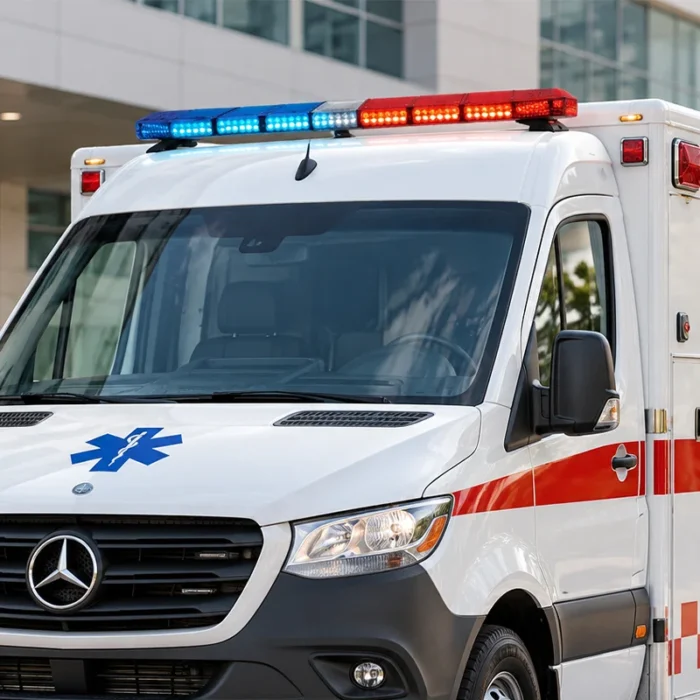
Ambulance warning-light systems should consider roof, rear and side visibility around the complete vehicle.
Start With the Ambulance Body, Not the Catalogue
Ambulance fleets rarely use one body style. Front-line ambulances, patient-transport vehicles, response cars and specialist units can all create different mounting and visibility conditions.
Before selecting a lightbar, map the vehicle:
- roof width, height and curvature;
- front and rear body profile;
- rear and side door positions;
- air-conditioning pods, vents and aerials;
- cameras, scene lights and antennas;
- controller and cable-routing space.
The roof lightbar then becomes one part of the fitout rather than the entire fitout. This vehicle-first approach also prevents buyers from treating all ambulance emergency light bars Australia as interchangeable simply because they belong to the same product category.
Think in Warning Zones
A practical specification divides the ambulance into front, front-quarter, side, rear-quarter and rear warning zones.
That matters because an ambulance may approach traffic head-on, cross an intersection, stop at an angle or remain parked with its rear facing approaching vehicles. Different motorists can therefore see very different parts of the same vehicle.
A roof lightbar may provide strong forward recognition while a high body or roof equipment reduces its prominence from behind. This is why emergency vehicle light bars Australia should be assessed on the completed vehicle, not only on an advertised optical-coverage claim.
Ask one question for every zone: can a road user clearly recognise the warning signal from this direction when the ambulance is configured as crews normally use it?
Roof, Rear and Supplementary Lighting Have Different Jobs
Roof lighting
The roof position gives the primary warning system height and long-range prominence. Fleet teams should assess product length, colour configuration, optics, mounting hardware and roof shape together.
A rapid-response car may keep its main bar visible from several directions because of its lower body. A high-roof ambulance may need a different layout. That is why procurement teams comparing roof mounted emergency light bars Australia should begin with vehicle dimensions rather than copying a fitout from another fleet.
Rear warning lighting
Rear visibility becomes particularly important when crews stop at a roadside scene. Rear doors may open, staff may move around the loading area and the vehicle may sit partly angled to traffic.
Check whether the primary bar remains visible with the vehicle in that normal working configuration. If the body or doors create a genuine gap, the fitout may need rear-facing supplementary warning lights.
Side and corner lighting
Intersections and angled approaches create another visibility problem. Compact supplementary LEDs can support an identified side or corner gap, but the aim is not to cover every panel with lights.
Each extra unit should solve a defined warning-coverage problem.
This distinction gives fleet buyers a much better basis for selecting emergency vehicle light bars Australia because the main bar and supplementary units each receive a clear job.
Treat Red and Blue as an Authorisation Question
Red and blue warning lighting carries a specific legal meaning in Australia. Fleet buyers should therefore confirm the vehicle’s authority before selecting colour.
Transport for NSW guidance states that blue, or blue-and-red flashing lights, may only be fitted to specified vehicles, including ambulances used by the Ambulance Service of NSW or vehicles authorised by it. South Australian government guidance likewise states that red and blue lights are only allowed on emergency vehicles such as police, fire and ambulance vehicles. Victoria’s vehicle standards identify qualifying ambulance-service vehicles within the emergency-vehicle category.
References & Official Sources: NSW Government
This matters for private patient-transport, event-medical and first-response operators. Performing medical work does not automatically give a vehicle the same warning-light permissions as an authorised emergency ambulance.
Before ordering emergency LED light bars in Australia, confirm the operator, vehicle classification, and state requirements first. Never treat red/blue colour selection as an ordinary product option.
Choose an Emergency-Specific Product Configuration
Do not force an amber commercial-fleet product into an ambulance specification simply because it is a high-output lightbar.
The standard ECCO 1200+ page, for example, lists 16 high-intensity amber LED modules on its standard models. It also lists 12–24V operation, several lengths and optional work or alley lights, but those features alone do not make the standard amber configuration an ambulance fitout.
ECCO 1200+ SERIES LED LIGHT BARS : Australian Warning Systems
AWS also carries emergency-focused products with red/blue configurations. The CODE 3 Pursuit Series offers red/blue options, lengths from 600mm to 2100mm, 10–30V operation and optional alley or front/rear spotlights. AWS also lists Whelen full-size roof-mounted lightbars with red, blue, amber and white configurations and programmable control options.
PURSUIT SERIES EMERGENCY LED LIGHTBAR: Australian Warning Systems
For buyers researching emergency LED light bars Australia, the better sequence is:
Confirm authority → map the ambulance → define coverage → specify controls → select the product.
That approach keeps product selection tied to the operational requirement.
Controller Integration Can Make or Break the Fitout
An ambulance warning package may combine a roof bar, grille or surface-mounted warning lights, rear lights, scene lighting, siren functions and other electrical equipment.
Fleet teams should define how those devices work together before approving hardware. The specification should identify:
- which warning devices activate together;
- required operating modes;
- flash-pattern synchronisation where compatible;
- separation of scene lighting from emergency warning functions;
- siren or controller integration;
- diagnostic and service access.
The objective is not to maximise the number of selectable flash patterns. Crews need predictable controls, and workshops need a system they can service consistently.
A well-planned control system also reduces the chance that different vehicles in the same fleet behave differently during the same type of response.
Check More Than 12V or 24V
Voltage compatibility only answers one part of the electrical question.
Installers must also consider current draw, circuit protection, cable routing, controller requirements, accessory loads, electromagnetic compatibility and the vehicle manufacturer’s installation constraints.
That matters when the ambulance also carries communications equipment, cameras, medical systems and additional scene or warning lights.
For roof mounted emergency light bars Australia, confirm the product specification and the completed electrical architecture rather than treating the voltage label as the full compatibility test.
The electrical design should also leave technicians practical access for diagnosis and replacement. A system becomes expensive to maintain when a small warning-light fault requires unnecessary removal of unrelated equipment.
Standardise the Fleet Without Copying One Layout
Consistency helps drivers and workshops, but one physical warning-light layout will not suit every ambulance body.
A fleet standard can define approved colours, controller logic, operating modes, inspection procedures, documentation and warning-coverage objectives. The installer can then adapt lightbar length, supplementary lighting and mounting to the vehicle.
A rapid-response SUV and a high-roof ambulance can follow the same control philosophy while using different physical layouts.
That gives procurement teams consistency without ignoring the vehicle.
It also makes future fleet replacement easier. Instead of telling a supplier to copy an older installation, the fleet can provide an approved performance and control specification and ask the installer to apply it appropriately to the new platform.
Inspect the Vehicle in Its Real Working Configuration
Do not sign off the system from installation photos alone.
After fitment, view the ambulance from the front, rear, sides and quarter angles. Keep normal roof equipment fitted. Open the rear doors if crews commonly work that way at scenes. Confirm whether the body or doors obscure any warning lights and whether supplementary units actually solve the intended gap.
Also verify mounting security, controller behaviour and warning modes.
Feed what you learn from the first completed vehicle into subsequent fleet builds. A small adjustment identified during the first fitout can prevent the same problem across another 10 or 20 vehicles.
This final vehicle-level inspection is one of the most important steps when specifying ambulance emergency light bars in Australia because catalogue specifications cannot reproduce every real installation condition.
Ambulance Fleet Specification Checklist
Before requesting a quote, provide:
- Vehicle details: make, model, year, roof/body type and electrical system.
- Operational role: front-line ambulance, rapid response, patient transport or specialist response.
- Authority: jurisdiction and approval basis for emergency warning colours.
- Obstructions: roof equipment, rear doors, pods, aerials and cameras.
- Warning zones: front, side, rear and quarter-angle coverage objectives.
- Controller requirements: operating modes, siren integration and switching logic.
- Supplementary lighting: why each additional warning or scene light is required.
- Service needs: warranty, replacement availability, wiring records and diagnostic access.
Australian Warning Systems supplies and installs warning-lighting systems for emergency and fleet vehicles from Hallam, Victoria. Its LED lightbar category includes dedicated emergency products as well as commercial warning-lighting options, which allows a fitout to begin with the vehicle requirement rather than a single predetermined model.
Explore the AWS lightbar range
The strongest ambulance warning package is not the one with the most LEDs. It is the one that gives an authorised fleet a coordinated, serviceable warning system around the actual vehicle.
Frequently Asked Questions
What colour warning lights can an ambulance use in Australia?
The answer depends on the vehicle’s authorisation and jurisdiction. NSW permits blue or blue-and-red flashing lights on specified authorised ambulances, while South Australia reserves red and blue lights for emergency vehicles such as ambulances, police and fire vehicles. Confirm the applicable state rules before ordering a colour configuration.
References & Official Sources: NSW Government
Is one roof lightbar enough for an ambulance?
Not always. The body, rear doors and roof equipment can reduce visibility from some directions. Inspect the complete vehicle and add supplementary warning lighting only where the approved design identifies a genuine coverage gap.
Can a private medical vehicle use red and blue ambulance lights?
Do not assume so. Medical work alone does not automatically give a private vehicle emergency-vehicle status. The operator should confirm its legal authority and vehicle classification before fitment.
What size LED lightbar should an ambulance use?
No single length suits every ambulance. Roof width, mounting points, body design, required warning coverage and other roof equipment all affect the choice. Select the product after assessing the specific vehicle.
Do ambulances need supplementary rear warning lights?
They may where a tall body, rear structure or open doors obstruct the primary roof warning signal. Assess rear and rear-quarter visibility in the vehicle’s normal scene configuration before specifying additional lights.
Can the same lighting setup be used on an ambulance and a rapid-response car?
A fleet can standardise control logic, approved colours and operating modes, but the physical layout may need to differ because the vehicles have different body profiles, mounting space and visibility obstructions.