


Your tow truck has an amber warning lightbar. But when you pull onto a busy roadside to recover a broken-down vehicle, will approaching drivers see your truck clearly enough to recognise the hazard?
That question matters more than how bright the lightbar looks in a catalogue. A recovery truck may spend one job parked on a suburban street and the next loading a damaged vehicle beside a highway. Its position, height, equipment and operating conditions can all change how other road users see its warning lights.
Choosing amber warning light bars Australia recovery operators can rely on means looking at the complete vehicle setup, not just the roof-mounted unit. You need to consider visibility, loading operations, mounting, electrical compatibility and the rules that apply where your trucks work.
For operators in Victoria, New South Wales and South Australia, the aim is straightforward: select warning equipment that suits the vehicle, supports safe recovery procedures and meets applicable requirements.
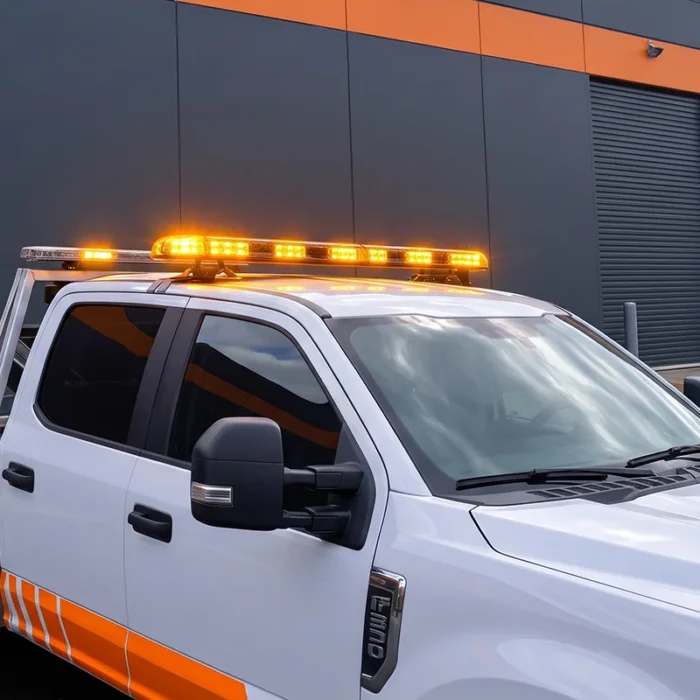
Amber warning lighting helps identify tow trucks during roadside recovery and vehicle loading operations.
Why a roof lightbar is only part of a tow truck’s warning setup
A roof-mounted lightbar gives a tow truck a prominent warning signal, particularly when it approaches a breakdown or stops to begin recovery. However, the vehicle’s body, recovery equipment, loading position and surrounding traffic can affect how visible that signal remains.
Consider a tilt-tray truck collecting a vehicle at night. The roof lightbar may remain clearly visible to traffic approaching from the front, while the raised tray or loaded vehicle changes the view from behind. A larger recovery vehicle may create different visibility challenges because its cab, bodywork and equipment occupy more space.
This does not mean every truck needs additional warning lights. It means the operator should assess visibility from the directions in which other vehicles may approach.
A practical assessment should consider:
- Whether approaching traffic can see the warning lightbar from the front, rear and sides.
- Whether the loading equipment or recovered vehicle obstructs the signal.
- Whether the vehicle operates mainly on local roads, highways or private sites.
- Whether the lighting configuration remains suitable during recovery operations.
The best tow truck warning lights Australia operators choose should suit the truck’s actual working conditions, rather than simply matching another vehicle in the fleet.
Amber lightbar or beacon: which is better for a tow truck?
Both amber beacons and roof-mounted lightbars can provide a visible warning signal, but they differ in design, installation and available functions.
A beacon usually provides a compact warning-light solution. A lightbar extends across a wider section of the roof and may offer different lighting modules, patterns and optional functions depending on the model.
Neither option automatically provides better visibility in every situation. The vehicle’s shape, mounting location, equipment and surroundings influence the result.
| Consideration | Amber beacon | Amber LED lightbar |
| Physical design | Compact warning unit | Wider roof-mounted assembly |
| Installation | May suit limited mounting space | Requires suitable roof space and brackets |
| Visibility | Depends on beacon design and position | Depends on lightbar design, length and position |
| Available features | Vary by model | May include multiple patterns and optional functions |
| Best selection method | Check the vehicle and application | Check the vehicle and application |
For a small recovery vehicle, a properly selected beacon may meet the operational need. A larger truck may benefit from a lightbar configuration that suits its roof and warning requirements. Some operators may use more than one warning device, subject to the vehicle’s needs and applicable rules.
The purchasing decision should begin with the recovery task, not an assumption that a larger lightbar is always safer.
What warning lights does a tow truck legally need in Australia?
Australian tow truck operators must consider the requirements of the state or territory where they operate. They should not assume that a warning-light configuration accepted in one jurisdiction automatically satisfies every requirement elsewhere.
In New South Wales, government tow truck guidance identifies a working amber flashing or rotating warning light and suitable loading lights among the required equipment for relevant tow trucks. Operators should also check the rules governing when and how warning lights may operate.
Victoria and South Australia have their own vehicle standards, towing requirements and road-use rules. Businesses operating across state borders should review the requirements that apply to each vehicle and operation rather than relying on a single national checklist.
Before purchasing or changing a lighting setup, confirm the following with the relevant authority and installer:
- The required warning-light colour and permitted operation.
- The requirements for the particular tow truck class.
- Whether mounting and visibility requirements apply.
- Any applicable vehicle modification or electrical installation requirements.
- Whether separate lighting is required for loading or working areas.
A lightbar’s advertised certification does not, by itself, establish that the complete installation complies with every Australian jurisdiction.
For current requirements, refer to NSW Government, VicRoads and SA Government and locate the guidance applicable to the vehicle and towing operation.
Why loading lights and warning lights perform different jobs
A common mistake is expecting one lighting system to handle every part of a recovery operation.
An amber warning lightbar alerts other road users to the presence of a working or potentially hazardous vehicle. Loading lights illuminate the working area so the operator can see the tray, attachment points and surrounding equipment.
Imagine recovering a vehicle after dark. The roof lightbar may provide a warning signal, but it may not illuminate the winch connection, wheel position or loading area sufficiently for the operator to complete the task.
Some lightbars offer optional work lights or alley lights. These features may support a particular application, but their suitability depends on where they direct light and how the operator uses them.
When reviewing vehicle warning light bars Australia suppliers offer, separate the questions: What warns approaching traffic, and what helps the recovery crew see the work area?
That distinction prevents businesses from selecting an expensive warning lightbar and later finding that they still need a separate loading-light solution.
Choosing the right roof-mounted lightbar for a recovery vehicle
A roof-mounted lightbar needs more than enough physical space to sit on the cab. It needs a suitable mounting arrangement, electrical connection and position that supports the vehicle’s intended use.
Start with the roof and any equipment already fitted. Roof racks, air deflectors, aerials, storage equipment and vehicle bodywork may affect where the lightbar can sit.
Next, consider the vehicle’s operating height. A low-profile design may be useful where overall clearance matters, but the installed height includes mounting feet and brackets, not just the lightbar housing.
For commercial recovery fleets, the ECCO 1200+ Series LED Light Bars provide an example of a low-profile warning-lightbar range worth evaluating. Australian Warning Systems lists 12–24V operation, multiple lengths, selectable warning patterns and optional lighting or controller features for the series.
Those specifications can help a buyer shortlist a configuration. They do not establish that every model, colour option or accessory suits every tow truck.
Useful AWS product links:
ECCO 1200+ Series LED Light Bars — review the model and available configurations.
AWS LED Lightbars — compare other warning-lightbar options.
The right product should follow the vehicle assessment, not replace it.
What Victoria, NSW and South Australia operators should know
The rules are not identical across these states, and that matters when a recovery company operates in more than one jurisdiction.
| State | Practical point for tow truck operators |
| New South Wales | NSW Government guidance requires relevant tow trucks to carry a working amber flashing or rotating warning light and fully adjustable mounted lights for loading and unloading after dark. |
| Victoria | Tow trucks are among the special-use vehicles that may carry yellow flashing warning lamps. Victoria’s 40 km/h passing rule also covers qualifying stationary or slow-moving towing and roadside-assistance vehicles with flashing lights or alarms. |
| South Australia | Flashing amber lights have restricted uses. Since May 2025, drivers must slow to 25 km/h when passing qualifying stationary breakdown-service vehicles displaying flashing amber lights. |
These are summaries, not complete vehicle approval requirements. Operators should confirm current rules for their exact vehicle and circumstances.
Driving or operating a tow truck in NSW
The different passing-speed rules also highlight an important distinction: a lightbar provides a warning signal, but it does not control how every approaching driver behaves. Recovery crews still need appropriate roadside procedures, positioning and other controls.
What should a tow truck fleet manager check before ordering?
Buying warning equipment for several recovery vehicles can create unnecessary expense if the business selects one configuration before reviewing its fleet.
A small roadside-assistance vehicle may have different roof space, voltage and equipment needs from a heavy recovery truck. Even two similar trucks can have different roof-mounted accessories or loading arrangements.
Before requesting a quotation, prepare a short specification for each vehicle group:
- Vehicle details: Make, model, year, roof configuration and electrical system.
- Recovery application: Tilt-tray, wheel-lift, heavy recovery or roadside assistance.
- Operating environment: Highway, metropolitan, regional or private-site work.
- Existing lighting: Current beacons, roof lightbars, loading lights and controls.
- Required functions: Amber warning patterns, mounting options and any separate work illumination.
- Installation requirements: Roof clearance, brackets, cable routing and access for maintenance.
This information helps a supplier recommend suitable warning light bars Australia recovery businesses can assess against their own requirements.
It also helps fleet managers compare quotations fairly. Two lightbars may have different prices because they include different lengths, controllers, mounting hardware or optional lighting features.
Checking warning lights before roadside recovery work
A warning-light system should remain reliable after installation. Recovery trucks face regular vibration, weather exposure and frequent equipment use, so operators need a practical inspection routine.
Before beginning a shift, check that the warning lights operate as expected and that the selected pattern is appropriate for the job. Inspect accessible lenses and mounts for visible damage, and report loose components or intermittent operation.
For night recovery work, check the separate loading lights as well. A functioning roof lightbar does not confirm that the operator can see the loading area adequately.
After equipment repairs or changes to roof-mounted accessories, confirm that nothing obstructs the warning lights or interferes with the installation. Where a fault involves wiring, controllers or mounting hardware, arrange inspection by a suitably qualified installer.
These checks support a more reliable fleet, but they do not replace the manufacturer’s maintenance instructions or the business’s formal safety procedures.
Choosing a warning-light setup that suits your recovery business
The right tow truck amber lightbar is not necessarily the longest or most expensive model. It is the configuration that suits the truck, supports its operating requirements and fits the broader recovery setup.
For some operators, that may mean a compact amber beacon. Others may need a roof-mounted LED lightbar with a suitable warning pattern, mounting system and optional lighting functions. Larger fleets may benefit from standardising approved configurations across similar vehicles while retaining different setups for specialist recovery trucks.
Australian Warning Systems supplies vehicle warning equipment and installation services for commercial applications. If you are comparing a new roof lightbar, replacing an older warning system or planning a fleet fitout, share the vehicle details and operating requirements before selecting the product.
View AWS LED Lightbars or contact Australian Warning Systems to discuss a suitable configuration.
The goal is not simply to put more lights on a tow truck. It is to select equipment that gives operators a practical, compliant warning system for the work they actually perform.
Frequently Asked Questions
Does a tow truck need an amber warning light in Australia?
Requirements depend on the state, vehicle and operation. NSW specifically requires relevant tow trucks to have a working amber flashing or rotating warning light. Victoria identifies tow trucks as special-use vehicles permitted to carry yellow flashing warning lamps. Operators should confirm the requirements that apply to their vehicles rather than assume one national rule covers every situation.
Is an amber beacon enough for a tow truck?
A suitable beacon may meet the needs of some vehicles, but the answer depends on the applicable rules, mounting, visibility and recovery operation. A roof lightbar may provide a different warning-light configuration. Operators should assess the complete vehicle rather than assume either design is universally sufficient.
Do tow trucks need separate loading lights?
NSW requires relevant tow trucks to have fully adjustable mounted lights for loading and unloading vehicles during darkness. Other jurisdictions and operating conditions may have different requirements. Warning lights and loading lights perform different functions, so operators should assess both.
Can tow trucks use blue or red warning lights?
Do not assume that a tow truck may use red or blue warning lights simply because a lightbar offers those colour options. Australian jurisdictions restrict warning-light colours and their use. Operators should verify their vehicle’s authorisation and the applicable rules before selecting or activating any restricted colour.
Can I install a 12–24V LED lightbar on any tow truck?
No. A 12–24V rating indicates the manufacturer’s stated operating-voltage range, not universal installation compatibility. The installer must also check mounting, wiring, circuit protection, controllers, accessories and the vehicle’s electrical requirements.
What should I check before buying warning lights for a fleet of tow trucks?
Record the vehicle types, electrical systems, roof arrangements, operating environments, existing lighting and required functions. Confirm applicable state requirements and identify any separate loading-light needs. This helps suppliers prepare more suitable quotations and reduces the risk of ordering incompatible equipment.